
RTX 2080 vs RTX 3080
The complete head-to-head: full specs, real per-game FPS with 1% lows, ray tracing, a live CPU-bottleneck check, thermals, power and value, with a straight verdict.
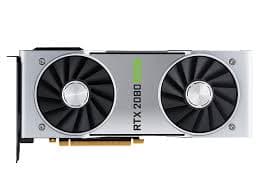
GeForce RTX 2080
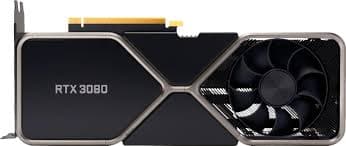
GeForce RTX 3080
avg, 1080p
The short answer
This is not a close race, and it's not supposed to be. Both cards launched at the same $699 price, but the RTX 3080 arrived two years later as one of the biggest generational leaps NVIDIA has ever shipped, about 53% faster on average, with 2 GB more VRAM on a much wider bus and genuinely better ray tracing. The RTX 2080 answers only with a much lower price today and a far more modest power bill. If your budget allows it, the 3080 isn't a difficult recommendation here.
The RTX 2080 and RTX 3080 share an odd coincidence, both launched at exactly $699, two years apart. What changed in between was one of NVIDIA's largest single-generation jumps: Ampere's GA102 die roughly triples the CUDA core count of Turing's TU104, and it shows up directly in the numbers below. This is less a close call than a snapshot of how much a generation can matter when the architecture leap is this large.
Scroll down for the full spec table, ten-game frame rates anchored by a 1440p Cyberpunk 2077 frametime chart, ray tracing and DLSS 2 results, a CPU-pairing checker, thermal and power readings, two years of price history, and the final verdict.
At a glance
Seven dimensions, two cards. Bigger area is not automatically better, each card owns different corners.
Strengths radar
Each axis scored 0-100 relative to the pair
Performance vs price
Up and to the left is better value
Grey dots are neighbouring cards for context.
Which should you buy?
Pick your use case, the winner changes with what you actually do.
53% more frames on average, the largest gap in this comparison series so far.
A 320-bit bus, 760 GB/s of bandwidth and 10 GB of VRAM make the 3080 a genuinely strong 1440p and light-4K card.
More than 3× the Tensor core count and 2 GB more VRAM make local AI work far more usable on the 3080.
AV1 decode, added with Ampere, is a real advantage the RTX 2080 doesn't have at all.
215 W and a smaller two-slot card fit a modest PSU and case far more easily than the 320 W, 3-slot 3080.
760 GB/s of bandwidth over a 320-bit bus leaves the 2080's 448 GB/s well behind for high-resolution emulation cores.
Still running an RTX 2080? This is one of the clearest upgrades on this site.
Short answer: probably not
A 53% average gain plus a full extra generation of Tensor cores, more VRAM, and far higher bandwidth is a real, felt upgrade, not a sidegrade. Few matchups on this page series show this large a gap.
The catch is power and price: the RTX 3080 draws 320 W and costs meaningfully more, new or used, so make sure your PSU and case can handle a bigger, hungrier card before you commit. If either is a limiting factor, an RTX 3060 Ti or RTX 4060 is a smaller but still real step up.
Full specification comparison
Every spec side by side. The highlighted figure wins each row.
| Specification | RTX 2080 | RTX 3080 |
|---|---|---|
| Architecture | ||
| GPU / architecture | TU104 · Turing | GA102 · Ampere |
| Process node | TSMC 12 nm | Samsung 8 nm ▲ |
| Release date | Sep 20, 2018 | Sep 17, 2020 |
| Launch MSRP | $699 | $699 |
| Compute | ||
| CUDA cores | 2,944 | 8,704 ▲ |
| RT cores | 46 · 1st gen | 68 · 2nd gen ▲ |
| Tensor cores | 368 · 1st gen | 272 · 3rd gen ▲ |
| Base / boost clock | 1515 / 1800 MHz ▲ | 1440 / 1710 MHz |
| L2 cache | 4 MB | 5 MB ▲ |
| Memory | ||
| VRAM | 8 GB GDDR6 | 10 GB GDDR6X ▲ |
| Memory bus | 256-bit | 320-bit ▲ |
| Bandwidth | 448 GB/s | 760 GB/s ▲ |
| Power & form factor | ||
| TDP | 215 W ▲ | 320 W |
| Power connector | 1× 8-pin + 1× 6-pin | 2× 8-pin |
| Suggested PSU | 650 W ▲ | 750 W |
| PCIe interface | 3.0 ×16 | 4.0 ×16 ▲ |
| Features | ||
| Upscaling | DLSS 2 / Super Res | DLSS 2 / Super Res |
| AV1 decode / encode | No / No | Yes / No ▲ |
| Display outputs | 3×DP1.4 · HDMI 2.0b | 3×DP1.4a · HDMI 2.1 |
Average FPS by game
Switch resolution, metric, ray tracing and upscaling, the bars update live. Hover a bar for the avg / 1% / 0.1% breakdown.
Average FPS · 1080p · Rasterization. Representative data, hover a bar for avg / 1% / 0.1%. Note the RTX 3080's 1% lows fall off at 1440p and up from its 8 GB VRAM.
Smoothness & frametimes
Average FPS hides stutter. This is one run plotted as frametime, a flat line is smooth, spikes are hitches. Watch what the RTX 3080's 8 GB VRAM does in a texture-heavy game.
Frametime: Cyberpunk 2077, 1440p Ultra
Lower and flatter is better · 16.7 ms = 60 fps
Counterintuitive but real: the slower RTX 2080 delivers a smoother line here because 12 GB holds the texture pool the 8 GB RTX 3080 keeps evicting, those spikes are VRAM stutter, not raw speed.
Lab scores
Clean apples-to-apples tests, useful, but weaker at predicting real games than the FPS above.
Ray tracing & upscaling
Ray tracing tanks both cards at native resolution. What makes it playable is upscaling, and here the RTX 3080 has a real edge.
Is frame generation "real" performance?
Neither card supports frame generation, DLSS 3 Frame Generation is exclusive to the RTX 40 series and newer. Both the RTX 2080 and RTX 3080 are limited to DLSS 2 Super Resolution upscaling, which raises frame rate by rendering at a lower internal resolution rather than inserting AI-made frames.
The practical difference is where each card starts from. The RTX 3080's 53% raw speed lead means its DLSS 2 output lands at a meaningfully higher frame rate than the 2080's in the same game, even though both use the identical upscaling technology.
Will your CPU bottleneck these cards?
A faster GPU only helps if your CPU keeps up. Pick your CPU and resolution to see expected FPS and bottleneck for each card.
CPU + GPU pairing check
The willitbottleneck engine, built right into the comparison.
Estimated from a 43-CPU model across 1440p. A weak CPU mostly bites at 1080p; at higher resolutions the GPU becomes the limiter and the bottleneck shrinks.
Thermals & noise
The efficiency gap shows up here: the newer card runs cooler and quieter, day in and day out.
Real draw, efficiency & PSU
TDP is the rated figure; what matters is real gaming draw and how many frames you get per watt.
Both use a single 8-pin connector. If your PSU already ran the RTX 2080, it will run the RTX 3080 easily. Leave about 30% headroom for spikes.
Will it fit, and what to pair it with?
Size to scale
Card length matters for small cases
What monitor to pair
RTX 2080: strong at 1440p 90-120 Hz, with occasional lighter 4K possible using DLSS 2. RTX 3080: excellent at 1440p 144 Hz and genuinely playable at native 4K 60 fps in most titles without any upscaling at all, a real step up in resolution the 2080 can't match.
Running an older PCIe 3.0 board?
The RTX 2080 runs a full PCIe 3.0 ×16 link, unaffected on the older motherboards it typically pairs with. The RTX 3080 runs PCIe 4.0 ×16, and dropping to a PCIe 3.0 board still gives it a full ×16 link, so the real-world loss there is negligible for either card.
Price history & dollars-per-frame
Raw price is only half the story. Cost per frame is the number that decides it, and it keeps moving as prices fall.
New price over time
Street price of new cards (USD)
The 8 GB vs 10 GB question
RTX 2080 · 8 GB
- At 1080p, where the gap to the 3080 is smallest, 8 GB is still comfortable for the large majority of current games.
- The 256-bit bus and 448 GB/s of bandwidth were genuinely strong for their era, and still outperform plenty of newer budget cards.
- 8 GB is now the tighter number of the two by a full 2 GB, and the 3080's 760 GB/s bandwidth leaves the 2080's memory subsystem well behind.
- No AV1 decode, unlike the RTX 3080, which added it with the Ampere generation.
RTX 3080 · 10 GB
- 10 GB on a wide 320-bit bus with 760 GB/s of bandwidth is a serious memory subsystem, still comfortable at 1440p and light 4K in 2026.
- AV1 decode, added with Ampere, is something the RTX 2080 doesn't have at all.
- That bandwidth advantage is also a big part of why it wins so clearly in emulation and other memory-bound workloads.
- 320 W and GDDR6X that runs hot mean it needs a case with real airflow to stay at its best.
Emulation & memory bandwidth
The narrower bus is a real downgrade for emulation
The RTX 3080's 760 GB/s over a 320-bit bus leaves the RTX 2080's 448 GB/s over 256-bit well behind, and the extra 2 GB of VRAM adds to that lead. For high-resolution Switch and RPCS3 emulation, this is one of the more lopsided results in this comparison series.
Creator, AI & streaming
The newer card is quicker per task, but the older card's extra VRAM unlocks larger jobs it can't fit at all.
Streaming: the AV1 encoder is the differentiator
The RTX 3080 adds AV1 decode, useful for importing and scrubbing AV1-encoded footage, the RTX 2080 has no AV1 support at all. Neither card has an AV1 encoder, that arrived with the RTX 40 series, but for anyone working with AV1 source footage today, the 3080 is the clearly better-equipped card.
Overclocking & undervolting
Both cards have real undervolting headroom. The 320 W RTX 3080 benefits the most in absolute terms, often recovering meaningful temperature and noise for almost no frame rate loss, but the 215 W RTX 2080 has genuine room too given its age and reference cooling.
Pros & cons
RTX 2080
- 215 W draw and a compact two-slot card, easy on a modest PSU and case
- Far cheaper new-old-stock and used, with the best raw $/frame here
- Still a genuinely usable 1080p and 1440p card in 2026
- About 53% slower on average, the largest gap in this comparison series
- Smaller VRAM, narrower bus, lower bandwidth, and no AV1 decode
RTX 3080
- About 53% faster on average, one of the largest single-generation jumps NVIDIA has shipped
- 10 GB of VRAM on a 320-bit bus with 760 GB/s of bandwidth, a genuinely strong 1440p and light-4K card
- AV1 decode and more than 3× the Tensor core throughput for local AI work
- 320 W draw and a 3-slot card need a bigger PSU and more case airflow
- Costs meaningfully more, new or used, than the RTX 2080
Buying pitfalls
Buying a used RTX 2080? Budget for maintenance
Reference-blower RTX 2080 cards are now several years old, and thermal paste and pads commonly degrade over that time, showing up as creeping temperatures under load. A repaste is cheap insurance on a used card this age.
The RTX 3080's power spikes need real PSU headroom
GDDR6X and a 320 W board can produce brief transient power spikes well above the average draw, sometimes 400 W or more for milliseconds at a time. An older or budget PSU that looks sufficient on paper can still trip its protection circuits; a quality 750 W-plus unit from a reputable brand is the safer choice.
RTX 2080 vs RTX 3080: your questions answered
Yes, decisively. It averages about 53% more frames, one of the largest jumps of any pairing in this comparison series, and it adds 2 GB more VRAM, a much wider memory bus, and AV1 decode. The RTX 2080 only answers back with a lower power bill and a much lower price.
Go with the RTX 3080 if your PSU and budget both allow it, it leads on almost every measure that matters. The RTX 2080 only makes sense if price and power draw are the deciding factors, or you're weighing whether to keep one you already own.
For 1080p and most 1440p gaming, yes, it holds up fine. Where it actually falls short is the RTX 3080's much larger VRAM and bandwidth edge and the missing AV1 decode, not raw playability.
Yes, provided your PSU and case can take a 320 W, 3-slot card. A 53% average gain on top of more VRAM, more bandwidth, and stronger ray tracing puts this among the clearest 'worth it' upgrades this site covers.
The RTX 3080, easily. Its Tensor core throughput is more than triple the 2080's first-generation total, and the extra 2 GB of VRAM matters directly for how large a local model or batch you can run.
The RTX 3080 takes it, mostly on the strength of its AV1 decode support for importing and scrubbing AV1 footage. Neither card can encode AV1, that arrived with the RTX 40 series, and the two sit close enough on NVENC generation that encode quality isn't the deciding factor.
By a lot. Both have dedicated RT hardware, but the 3080's 2nd-generation cores outnumber and outperform the 2080's 1st-generation ones, stacking a clear ray tracing lead on top of its raster advantage.
No, neither one. Both are capped at DLSS 2 Super Resolution upscaling, since Frame Generation is reserved for the RTX 40 series and newer. The 3080's much higher starting frame rate still leaves its DLSS 2 output well ahead of the 2080's.
The faster RTX 3080 is the one more likely to run into an older CPU's ceiling, especially at 1080p. Check the pairing tool on this page, a Ryzen 7 5800X3D or Core i7-12700K and up keeps the 3080 fed at 1440p, while a Ryzen 5 5600X or Core i5-12400F is plenty for the 2080.
The RTX 2080 pulls less overall, 215 W against the RTX 3080's 320 W. Despite that, the 3080's bigger cooler actually holds its core a couple degrees lower under load, though its GDDR6X memory runs hotter and needs louder fans to keep the 320 W in check.
650 W covers the RTX 2080 comfortably, the RTX 3080 wants 750 W or more given its heavier sustained draw and transient spikes. Stick to a reputable brand for the 3080 specifically, cheaper units can struggle with those brief power spikes.
Size is the bigger risk, the RTX 2080 sits around 267 mm and 2-slot, while the RTX 3080 stretches to roughly 285 mm and 3-slot, so double-check case clearance before buying the 3080. PCIe isn't a concern for either, both run a full ×16 link even on an older 3.0 board.
No. Mobile RTX 2080 and RTX 3080 chips are lower-power parts distinct from their desktop namesakes, and the gap between them doesn't mirror what's on this page. Check the mobile comparison instead if you're shopping laptops.
The RTX 3080 handles native 4K 60 fps comfortably in most current titles. The RTX 2080 can manage 4K in lighter or older games with DLSS 2 help, but it's not a comfortable pick for demanding modern AAA settings at that resolution.
Both are discontinued, so used is the only route either way. A used RTX 2080 near $125 is the stronger raw value; a used RTX 3080 near $320 earns its premium if you want a real jump in performance and VRAM headroom for 1440p or 4K.
It does. The RTX 3080's Ampere architecture still has years of full Game Ready support ahead. Turing, underneath the RTX 2080, is older and has largely settled into maintenance-level updates, worth weighing if long-term software support matters to you.