
RTX 4070 vs RTX 5070
The complete head-to-head: full specs, real per-game FPS with 1% lows, ray tracing, a live CPU-bottleneck check, thermals, power and value, with a straight verdict.
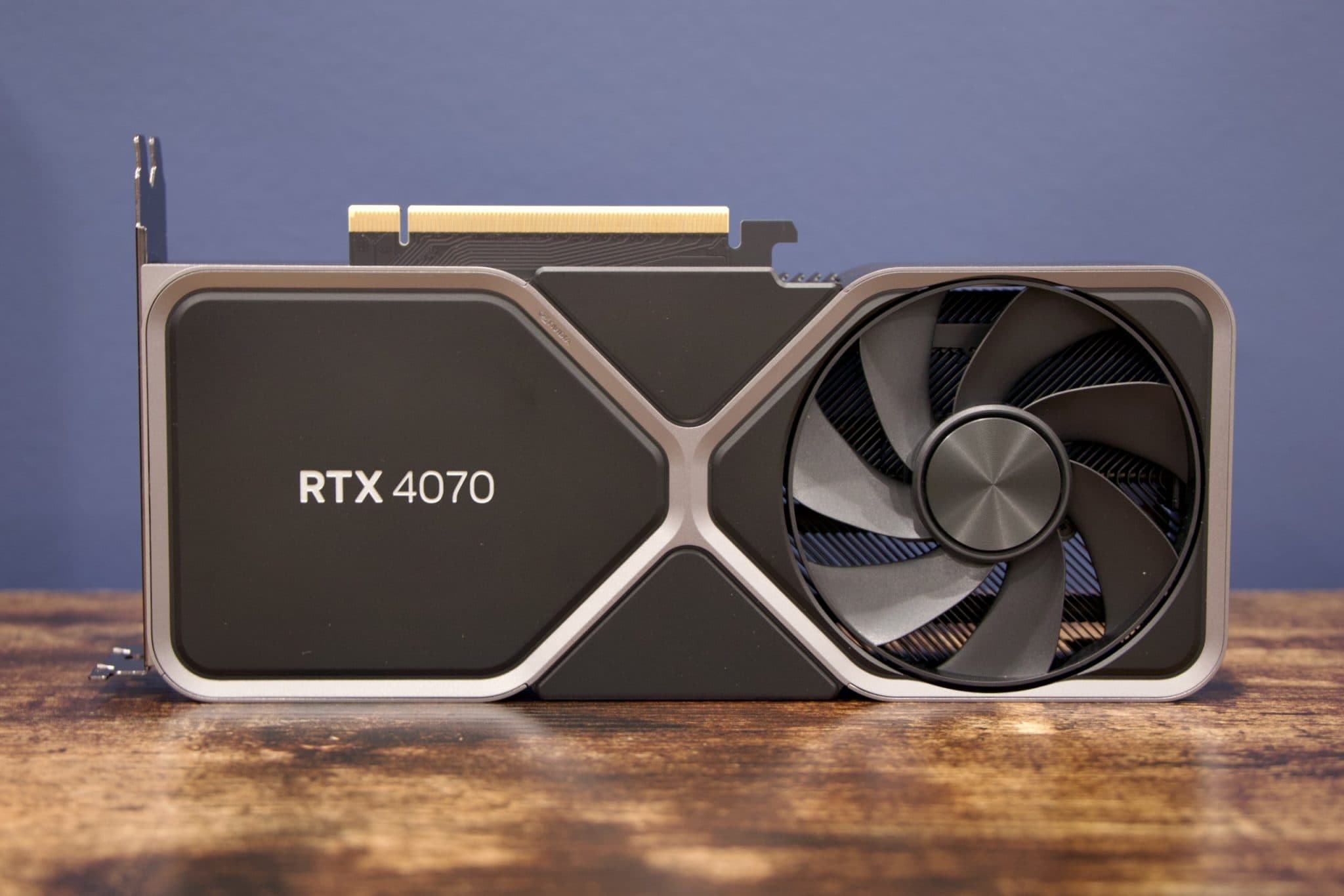
GeForce RTX 4070
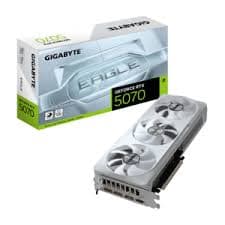
GeForce RTX 5070
avg, 1080p
The short answer
The RTX 5070 is the newer, faster card, about 20% ahead of the RTX 4070 on average at 1080p, and it launched at $50 below the 4070's original price. It adds GDDR7 memory, DLSS 4 with Multi Frame Generation, and a second AV1 encoder for streamers and editors. The catch is power: it draws 50 W more, so the generational leap is real but not free. Both cards carry the same 12 GB of VRAM, so this comparison comes down to speed, features, and price, not memory headroom.
These two sit at the same price tier, one generation apart, which makes them a natural comparison for anyone building around $500-550. The 5070 is the successor: faster core, newer memory, and NVIDIA's latest upscaling stack. The 4070 is the known quantity, widely available and cheaper now that the 5070 has taken its spot at the top of the lineup.
This page walks through both cards' full spec sheets side by side, the ten-game 1080p benchmark run with 1% lows, how each handles ray tracing under DLSS 3 versus DLSS 4, a CPU-pairing checker tuned to this exact matchup, thermal and power readings, two years of street pricing, and a clear call on whether the 5070's 20% lead is worth its higher price and power draw.
At a glance
Seven dimensions, two cards. Bigger area is not automatically better, each card owns different corners.
Strengths radar
Each axis scored 0-100 relative to the pair
Performance vs price
Up and to the left is better value
Grey dots are neighbouring cards for context.
Which should you buy?
Pick your use case, the winner changes with what you actually do.
20% more average fps for a lower launch price than the card it replaces. The easy default for a fresh build at this budget.
Newer 4th-gen RT cores plus the DLSS 4 transformer model close the gap in path-traced titles noticeably more than the raster numbers alone suggest.
Same 12 GB ceiling on both cards, but the 5070's 672 GB/s of GDDR7 bandwidth moves data faster during inference and training.
A second hardware AV1 encoder lets the 5070 encode a stream and record locally at once without the quality hit the 4070 takes doing the same.
200 W against 250 W matters in a compact case with tighter airflow or an older 650 W supply with less headroom.
Higher memory bandwidth helps most at the high internal resolutions emulators use, and the 5070 has 33% more of it.
Already own an RTX 4070? Skip this one.
Short answer: probably not
A 20% average gain is a real but modest jump, and you would be spending real money to get it while your VRAM ceiling stays exactly the same at 12 GB. Unless you specifically want Multi Frame Generation or the dual encoders for streaming, keep the 4070 and put the money toward something bigger.
If you do want to move up, an RTX 5070 Ti or RTX 4080 Super is a genuine 45-55% jump and a better use of the budget than a lateral 20% move within the same VRAM tier.
Full specification comparison
Every spec side by side. The highlighted figure wins each row.
| Specification | RTX 4070 | RTX 5070 |
|---|---|---|
| Architecture | ||
| GPU / architecture | AD104 · Ada Lovelace | GB205 · Blackwell |
| Process node | TSMC 4N (5 nm class) | TSMC 4NP (5 nm class) |
| Release date | Apr 13, 2023 | Mar 5, 2025 |
| Launch MSRP | $599 | $549 ▲ |
| Compute | ||
| CUDA cores | 5,888 | 6,144 ▲ |
| RT cores | 46 · 3rd gen | 48 · 4th gen ▲ |
| Tensor cores | 184 · 4th gen | 192 · 5th gen ▲ |
| Base / boost clock | 1920 / 2475 MHz | 2160 / 2510 MHz ▲ |
| L2 cache | 36 MB | 48 MB ▲ |
| Memory | ||
| VRAM | 12 GB GDDR6X | 12 GB GDDR7 ▲ |
| Memory bus | 192-bit | 192-bit |
| Bandwidth | 504 GB/s | 672 GB/s ▲ |
| Power & form factor | ||
| TDP | 200 W ▲ | 250 W |
| Power connector | 1× 16-pin (12VHPWR) | 1× 16-pin (12V-2x6) |
| Suggested PSU | 650 W | 650 W |
| PCIe interface | 4.0 ×16 | 5.0 ×16 ▲ |
| Features | ||
| Upscaling | DLSS 3 + Frame Gen | DLSS 4 + Multi Frame Gen ▲ |
| AV1 encode (NVENC) | Yes · 1 encoder | Yes · 2 encoders ▲ |
| Display outputs | 3×DP1.4a · HDMI 2.1 | 3×DP2.1 · HDMI 2.1b ▲ |
Average FPS by game
Switch resolution, metric, ray tracing and upscaling, the bars update live. Hover a bar for the avg / 1% / 0.1% breakdown.
Average FPS · 1080p · Rasterization. Representative data, hover a bar for avg / 1% / 0.1%. Note the RTX 5070's 1% lows fall off at 1440p and up from its 8 GB VRAM.
Smoothness & frametimes
Average FPS hides stutter. This is one run plotted as frametime, a flat line is smooth, spikes are hitches. Watch what the RTX 5070's 8 GB VRAM does in a texture-heavy game.
Frametime: Alan Wake 2, 1440p Ultra
Lower and flatter is better · 16.7 ms = 60 fps
Counterintuitive but real: the slower RTX 4070 delivers a smoother line here because 12 GB holds the texture pool the 8 GB RTX 5070 keeps evicting, those spikes are VRAM stutter, not raw speed.
Lab scores
Clean apples-to-apples tests, useful, but weaker at predicting real games than the FPS above.
Ray tracing & upscaling
Ray tracing tanks both cards at native resolution. What makes it playable is upscaling, and here the RTX 5070 has a real edge.
Is frame generation "real" performance?
Both cards support DLSS Frame Generation, but not the same version. The 4070 gets DLSS 3's single Frame Generation, one AI frame inserted between two real ones. The 5070 runs DLSS 4's Multi Frame Generation, which can insert up to three AI frames per real one, so the counter climbs much further on a high-refresh monitor.
Use it for single-player and cinematic games with a healthy base frame rate, at least 50-60 fps before you turn it on. Skip it for competitive shooters, where the added latency works against you, and remember neither version reacts to your input on the inserted frames, NVIDIA Reflex offsets most but not all of that lag.
Will your CPU bottleneck these cards?
A faster GPU only helps if your CPU keeps up. Pick your CPU and resolution to see expected FPS and bottleneck for each card.
CPU + GPU pairing check
The willitbottleneck engine, built right into the comparison.
Estimated from a 43-CPU model across 1440p. A weak CPU mostly bites at 1080p; at higher resolutions the GPU becomes the limiter and the bottleneck shrinks.
Thermals & noise
The efficiency gap shows up here: the newer card runs cooler and quieter, day in and day out.
Real draw, efficiency & PSU
TDP is the rated figure; what matters is real gaming draw and how many frames you get per watt.
Both use a single 8-pin connector. If your PSU already ran the RTX 4070, it will run the RTX 5070 easily. Leave about 30% headroom for spikes.
Will it fit, and what to pair it with?
Size to scale
Card length matters for small cases
What monitor to pair
RTX 4070: strong at 1440p 100-165 Hz, capable at 4K 60 Hz with DLSS. RTX 5070: the same 1440p sweet spot with more headroom, and a more comfortable 4K 60-90 Hz with DLSS 4 doing more of the work. Neither is a native 4K-ultra card without upscaling.
Running an older PCIe 3.0 board?
The 5070 runs PCIe 5.0 ×16, but no consumer GPU today saturates even 4.0 bandwidth, so it is a future-proofing spec, not a real-world gain. The 4070's PCIe 4.0 ×16 loses nothing in practice on a 4.0 or 5.0 motherboard, and even a 3.0 board costs only a couple of percent.
Price history & dollars-per-frame
Raw price is only half the story. Cost per frame is the number that decides it, and it keeps moving as prices fall.
New price over time
Street price of new cards (USD)
The 12 GB vs 12 GB question
RTX 4070 · 12 GB
- 12 GB comfortably covers 1440p ultra textures in nearly every 2026 release.
- Same capacity as the RTX 5070, so you give up no VRAM headroom by buying the older card.
- 504 GB/s of bandwidth trails the 5070's 672 GB/s, which shows up most in ray tracing and at 1440p and up.
- A single AV1 encoder means heavier export or stream-and-record workflows lean harder on the core.
RTX 5070 · 12 GB
- 672 GB/s of GDDR7 bandwidth, about a third more than the 4070, keeps the extra compute fed at 1440p and in ray tracing.
- Dual AV1 encoders cut export and live-encode time roughly in half versus the 4070's single encoder.
- Still capped at 12 GB, so it is not the card for the largest local AI models or full 4K texture packs, that needs 16 GB.
- Draws 50 W more than the 4070 for the same VRAM size, the bandwidth and speed are not free.
Emulation & memory bandwidth
The narrower bus is a real downgrade for emulation
Both cards handle Switch, Wii U, PS3 and PS2 emulation without trouble even at high internal resolutions. Where they differ is memory bandwidth, and RPCS3 and Ryujinx-style cores scale with it at 4x-8x internal resolution. The 5070's 672 GB/s gives it more headroom for the heaviest emulation workloads than the 4070's 504 GB/s, though most players will not notice a difference below 4K output.
Creator, AI & streaming
The newer card is quicker per task, but the older card's extra VRAM unlocks larger jobs it can't fit at all.
Streaming: the AV1 encoder is the differentiator
Both have hardware AV1 encoders, a real jump over H.264 for quality-per-bitrate on YouTube, Discord and Twitch. The 5070's second encoder is the bigger practical win: it lets you encode a live stream and a separate local recording at full quality simultaneously, something the 4070's single encoder has to compromise on.
Overclocking & undervolting
Neither card has much overclocking headroom left on the table, both already run close to their efficiency limit out of the box. Undervolting is the better use of time on either one: similar performance at a noticeably lower temperature and noise floor.
Pros & cons
RTX 4070
- Cheaper new and used, and easy to find
- Same 12 GB VRAM as the card that replaced it
- 200 W is easy on PSU headroom and case airflow
- About 20% slower on average
- Single AV1 encoder and DLSS 3 only, no Multi Frame Generation
RTX 5070
- About 20% faster while staying in the same VRAM tier
- Dual AV1 encoders and DLSS 4 Multi Frame Generation
- Higher GDDR7 bandwidth helps most at 1440p and in ray tracing
- Draws 50 W more, worth checking your PSU and case airflow
- Costs more, new and used, than the 4070
Buying pitfalls
Which RTX 4070 are you buying?
The plain 4070, the 4070 Super, and the 4070 Ti Super are three different cards with different core counts and prices, easy to mix up while shopping. This page covers the original, non-Super RTX 4070 only. Check the listing carefully before you buy.
Laptop chips share the name, not the performance
Laptop RTX 4070 and RTX 5070 GPUs are cut-down parts that trail their desktop namesakes by a wide margin, and laptop-to-laptop or desktop-to-desktop is the only fair comparison. Never assume a laptop card matches the desktop numbers on this page.
RTX 4070 vs RTX 5070: your questions answered
Yes on speed, it averages about 20% higher frame rates at 1080p across the ten-game test set on this page, and it brings DLSS 4 Multi Frame Generation plus a second AV1 encoder the 4070 lacks. VRAM is a wash, both stick to 12 GB, so everything the 5070 wins comes from speed and features, not extra memory.
Go with the 5070 if the roughly $50-70 premium over 4070 street pricing fits comfortably, since it is both faster and better on efficiency per frame. Go with the 4070 if you spot one selling noticeably below that, used or on clearance, the 20% gap is meaningful but not worth chasing at any price.
No. It still runs 1440p at ultra settings without strain and handles 4K once DLSS kicks in, and its 12 GB of VRAM keeps it usable for a while longer. It trails the newer card, it just is not outdated.
Usually not. A 20% speed bump with an identical 12 GB VRAM ceiling does not justify the cost of trading in a card you already own. Put that money toward a 5070 Ti or 4080 Super instead, either one clears a real 45-55% gap over what you have now.
The 5070 pulls ahead, though not by a huge margin. Neither card exceeds 12 GB, so both hit the same wall with the largest local models, but the 5070's faster GDDR7 memory and newer tensor cores get inference and render jobs done quicker.
Usually. The 5070 carries two hardware AV1 encoders against the 4070's one, so you can stream live and record a separate local file at full quality at the same time, and AV1-aware editors export faster on the newer card.
Both have dedicated RT hardware, but the 5070's cores are a newer 4th-generation design that pulls further ahead specifically in path-traced titles, more than the plain rasterization numbers suggest. Pairing either one with DLSS keeps frame rates playable in the heaviest RT games.
The 4070 runs DLSS 3, which inserts a single AI-generated frame between two rendered ones. The 5070's DLSS 4 can insert up to three, pushing the on-screen counter noticeably higher on a fast monitor. Both add a bit of input lag, and NVIDIA Reflex claws back most, not all, of it on either card.
It can, and the faster 5070 is the more likely one to get capped by a weak processor at that resolution. Run the pairing checker further up this page; a Ryzen 7 5700X or Core i5-12600K or better keeps either card fed once you move to 1440p.
The 4070 pulls about 195 W in real gameplay against the 5070's 225-250 W, which shows up as a few degrees lower temperature and a slightly quieter fan curve. Both go silent at idle with fan-stop engaged.
NVIDIA lists 650 W as the recommended supply for either card, both running off a single 16-pin connector. A solid 650-750 W unit leaves comfortable headroom whichever one you are building around.
Founders Edition length runs 242-244 mm at 2 slots on both, though partner cards often run longer, so measure your case's clearance first. As for PCIe 5.0 on the 5070, it is a forward-looking spec only, neither card gives up meaningful performance plugged into a 4.0 motherboard.
No, laptop RTX 4070 and RTX 5070 chips are cut-down parts that fall well short of their desktop counterparts. Only compare laptop against laptop, or desktop against desktop, never across the two.
With DLSS doing the heavy lifting, yes, comfortably in most titles. Asking either card for native 4K ultra with no upscaling in a demanding 2026 release is a stretch. Think of 4K as a DLSS-assisted target on both cards rather than something either handles natively.
A used 4070 around $380 makes sense on a tight budget. A new 5070 around $509 is the smarter buy if you can stretch that far, since it comes with a full warranty plus DLSS 4 and the second encoder the 4070 does not have.
Yes to both. They are current Ada Lovelace and Blackwell architectures with full Game Ready driver support today, so driver longevity is not something to worry about with either purchase in 2026.