
RX 6500 XT vs RTX 3050
The complete head-to-head: full specs, real per-game FPS with 1% lows, ray tracing, a live CPU-bottleneck check, thermals, power and value, with a straight verdict.
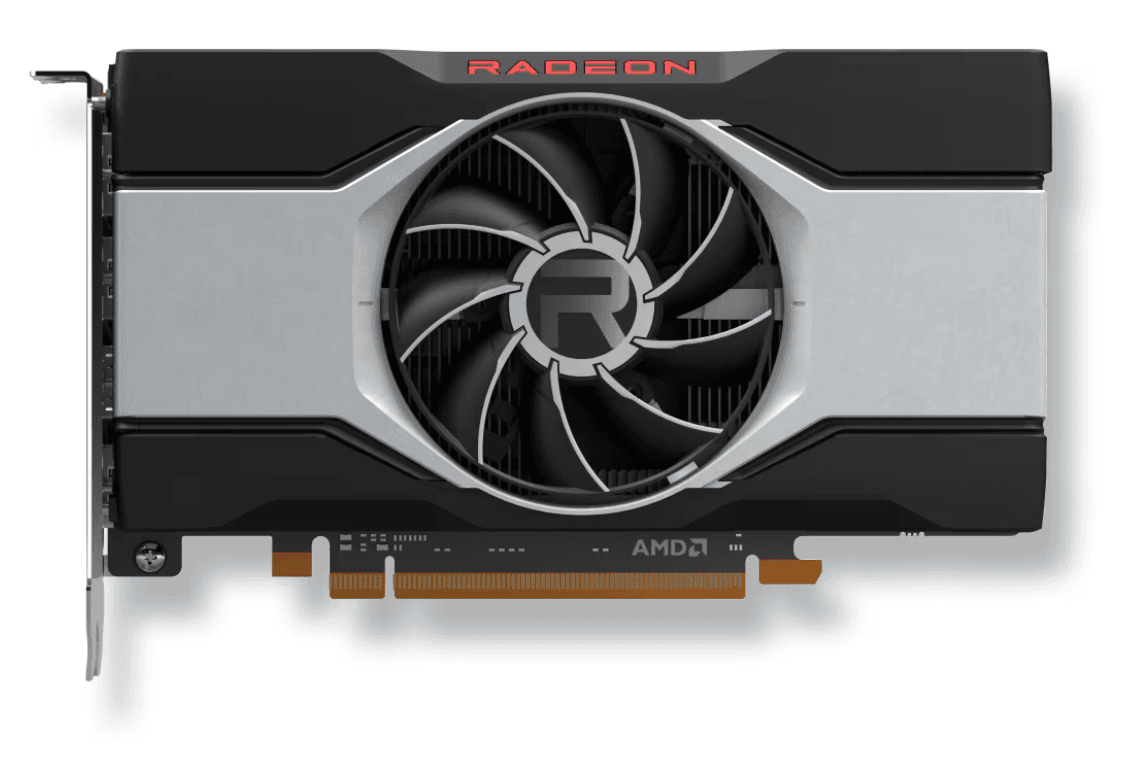
Radeon RX 6500 XT
GeForce RTX 3050
avg, 1080p
The short answer
This is not a close race. The RTX 3050 is about 53% faster on average, carries double the VRAM at 8 GB against a genuinely narrow 4 GB, and has a real, working hardware video encoder, ray tracing, and DLSS. The RX 6500 XT was a cut-down card from day one, a 64-bit memory bus, only 4 PCIe lanes wired, and no video encode block at all, and it shows in almost every category on this page. The 6500 XT's only real advantage is price. Buy the RTX 3050 unless your budget genuinely cannot stretch past $150, it is the far better card for the money.
These two launched within nine days of each other in January 2022 at nearly the same $199 to $249 price point, but they are not equals. AMD built the RX 6500 XT down to a strict cost target, a 64-bit memory bus, 4 GB of VRAM, and only 4 PCIe lanes wired despite the physical x16 slot. NVIDIA's RTX 3050 kept a full 128-bit bus, 8 GB of VRAM, real ray tracing hardware, and DLSS.
Scroll down for the 1080p frame rates, a CPU-pairing check, thermals, power draw and price history, all built around one question, how much does the 6500 XT's narrow bus actually cost you against a card that never had that limit.
At a glance
Seven dimensions, two cards. Bigger area is not automatically better, each card owns different corners.
Strengths radar
Each axis scored 0-100 relative to the pair
Performance vs price
Up and to the left is better value
Grey dots are neighbouring cards for context.
Which should you buy?
Pick your use case, the winner changes with what you actually do.
The 3050's 53% lead and real headroom keep frame rates high and consistent where the 6500 XT starts to strain.
8 GB of VRAM and a proper 128-bit bus avoid the stutter the 6500 XT's 4 GB hits in texture-heavy games.
The RTX 3050 has real Tensor Cores and double the VRAM, the RX 6500 XT has neither and struggles badly here.
The RX 6500 XT shipped with no hardware video encoder at all, the RTX 3050's NVENC is a real feature, not a footnote.
If $150 is the hard ceiling, the RX 6500 XT still beats integrated graphics by a wide margin.
For esports-only, pre-2020 titles at 1080p, the 6500 XT's real weaknesses matter less and the price gap is the deciding factor.
Already own an RX 6500 XT? The RTX 3050 is a genuine, worthwhile upgrade.
Short answer: probably not
Unlike most same-tier swaps on this site, this one is a real upgrade, not a sidegrade. A 53% average gain, double the VRAM, a working video encoder, and actual ray tracing and DLSS support add up to a meaningfully better PC, not a marginal one.
If the RTX 3050 is out of budget, an RX 6600 costs more but delivers an even bigger jump with a full 128-bit bus and 8 GB of VRAM. Either is a real step up from the 6500 XT's specific set of cuts.
Full specification comparison
Every spec side by side. The highlighted figure wins each row.
| Specification | RX 6500 XT | RTX 3050 |
|---|---|---|
| Architecture | ||
| GPU / architecture | Navi 24 · RDNA 2 | GA106 · Ampere |
| Process node | TSMC 6 nm ▲ | Samsung 8 nm |
| Release date | Jan 19, 2022 | Jan 27, 2022 |
| Launch MSRP | $199 ▲ | $249 |
| Compute | ||
| Cores | 1,024 stream processors | 2,560 CUDA cores ▲ |
| RT cores | 16 · 1st gen (very weak) | 20 · 2nd gen ▲ |
| Tensor / AI cores | None | 80 · 3rd gen Tensor ▲ |
| Base / boost clock | 2310 / 2815 MHz ▲ | 1552 / 1777 MHz |
| L2 / Infinity Cache | 16 MB Infinity Cache ▲ | 2 MB L2 |
| Memory | ||
| VRAM | 4 GB GDDR6 | 8 GB GDDR6 ▲ |
| Memory bus | 64-bit | 128-bit ▲ |
| Bandwidth | 144 GB/s | 224 GB/s ▲ |
| Power & form factor | ||
| TDP | 107 W ▲ | 130 W |
| Power connector | 1× 6-pin ▲ | 1× 8-pin |
| Suggested PSU | 300 W ▲ | 550 W |
| PCIe interface | 4.0 ×4 (physical ×16 slot) | 4.0 ×8 ▲ |
| Features | ||
| Upscaling | FSR 2 (no DLSS) | DLSS 2 / Super Res ▲ |
| Hardware video encoder | None, CPU/software only | NVENC, no AV1 ▲ |
| Display outputs | 1×DP1.4 · 1×HDMI2.1 | 3×DP1.4a · HDMI2.1 ▲ |
Average FPS by game
Switch resolution, metric, ray tracing and upscaling, the bars update live. Hover a bar for the avg / 1% / 0.1% breakdown.
Average FPS · 1080p · Rasterization. Representative data, hover a bar for avg / 1% / 0.1%. Note the RTX 3050's 1% lows fall off at 1440p and up from its 8 GB VRAM.
Smoothness & frametimes
Average FPS hides stutter. This is one run plotted as frametime, a flat line is smooth, spikes are hitches. Watch what the RTX 3050's 8 GB VRAM does in a texture-heavy game.
Frametime: Hogwarts Legacy, 1080p Medium
Lower and flatter is better · 16.7 ms = 60 fps
Counterintuitive but real: the slower RX 6500 XT delivers a smoother line here because 12 GB holds the texture pool the 8 GB RTX 3050 keeps evicting, those spikes are VRAM stutter, not raw speed.
Lab scores
Clean apples-to-apples tests, useful, but weaker at predicting real games than the FPS above.
Ray tracing & upscaling
Ray tracing tanks both cards at native resolution. What makes it playable is upscaling, and here the RTX 3050 has a real edge.
Is frame generation "real" performance?
Neither card supports DLSS Frame Generation. That needs an Optical Flow Accelerator, hardware that only arrived with RTX 40-series (Ada Lovelace) cards, so the Ampere-based RTX 3050 misses out just like the RX 6500 XT does.
AMD's FSR 3 Frame Generation runs through the game engine rather than fixed hardware, so it technically works on both cards, but it needs a decent base frame rate to look right, something the 4 GB, 64-bit RX 6500 XT rarely delivers in demanding games. In practice, treat frame generation as off the table for this pairing.
Will your CPU bottleneck these cards?
A faster GPU only helps if your CPU keeps up. Pick your CPU and resolution to see expected FPS and bottleneck for each card.
CPU + GPU pairing check
The willitbottleneck engine, built right into the comparison.
Estimated from a 43-CPU model across 1440p. A weak CPU mostly bites at 1080p; at higher resolutions the GPU becomes the limiter and the bottleneck shrinks.
Thermals & noise
The efficiency gap shows up here: the newer card runs cooler and quieter, day in and day out.
Real draw, efficiency & PSU
TDP is the rated figure; what matters is real gaming draw and how many frames you get per watt.
Both use a single 8-pin connector. If your PSU already ran the RX 6500 XT, it will run the RTX 3050 easily. Leave about 30% headroom for spikes.
Will it fit, and what to pair it with?
Size to scale
Card length matters for small cases
What monitor to pair
RX 6500 XT: best at 1080p on medium settings, 60 to 75 Hz in most games, and its narrow bus shows up as inconsistent 1% lows. RTX 3050: 1080p on high settings comfortably, and DLSS extends it into light 1440p territory. Neither is a real 4K card.
Running an older PCIe 3.0 board?
This matters a lot for the RX 6500 XT specifically. It only wires 4 PCIe lanes despite sitting in a physical x16 slot, and on an older PCIe 3.0 motherboard that link runs at roughly PCIe 3.0 x4 speed, about a quarter of a full x16 3.0 link. Combined with only 4 GB of VRAM, that narrow pipe becomes a real bottleneck once a game spills past VRAM, reviewers measured losses over 20 to 30% in some titles on PCIe 3.0 systems. If your motherboard is PCIe 3.0 only, budget for this loss or skip the 6500 XT. The RTX 3050 runs a full PCIe 4.0 x8 link and loses only a few percent even on PCIe 3.0.
Price history & dollars-per-frame
Raw price is only half the story. Cost per frame is the number that decides it, and it keeps moving as prices fall.
New price over time
Street price of new cards (USD)
The 4 GB vs 8 GB question
RX 6500 XT · 4 GB
- 4 GB is enough for esports titles and older games at 1080p medium settings, where the 64-bit bus matters less.
- The 64-bit memory bus is the real problem, it starves the GPU even in games that fit inside 4 GB, not just ones that exceed it.
- Only 4 PCIe lanes are wired, so once VRAM overflows, data has to cross a narrow PCIe link too, compounding the slowdown.
- Texture-heavy modern titles like Hogwarts Legacy and Alan Wake 2 show the largest gaps to the RTX 3050 in the numbers above, this is why.
RTX 3050 · 8 GB
- 8 GB on a full 128-bit bus is a real, comfortable amount for 1080p and light 1440p gaming in 2026.
- DLSS reduces the render resolution and eases memory pressure at the same time, a double benefit the 6500 XT can't match.
- A full PCIe 4.0 x8 link means no compounding bottleneck if a game does push toward the VRAM ceiling.
- 8 GB is still an entry-level ceiling, don't expect headroom for heavy modding or 4K textures.
Emulation & memory bandwidth
The narrower bus is a real downgrade for emulation
The RX 6500 XT's 64-bit bus and 144 GB/s of bandwidth are a serious limitation for bandwidth-hungry emulators like RPCS3 or Switch cores run above native resolution, both will stutter noticeably sooner than on the RTX 3050's 128-bit, 224 GB/s memory system. Combined with only 4 GB of VRAM, the 6500 XT is a poor emulation choice. The RTX 3050 handles upscaled emulation comfortably by comparison.
Creator, AI & streaming
The newer card is quicker per task, but the older card's extra VRAM unlocks larger jobs it can't fit at all.
Streaming: the AV1 encoder is the differentiator
This is not close. The RX 6500 XT and its sibling the RX 6400 shipped with no hardware video encode block at all, AMD cut it to save die space. Streaming or recording from this card means falling back to slow, CPU-heavy software encoding. The RTX 3050 has a full NVENC encoder built in, the difference in practical usability for content creation is enormous.
Overclocking & undervolting
Both cards have limited headroom. The RTX 3050's Ampere architecture is more mature for tuning and typically nets a bit more from overclocking or undervolting than the 6500 XT's cut-down Navi 24 die, which is already running close to its efficiency ceiling out of the box.
Pros & cons
RX 6500 XT
- About 40% cheaper than the RTX 3050, new or used
- Lower absolute power draw and a smaller 300 W PSU requirement
- Still a real step up from integrated graphics for esports titles
- No hardware video encoder at all, software encode only
- Only 4 GB VRAM on a 64-bit bus, and just 4 PCIe lanes wired
RTX 3050
- About 53% faster on average, a real generational gap, not a sidegrade
- 8 GB of VRAM on a full 128-bit bus with a proper PCIe 4.0 x8 link
- Real ray tracing hardware, DLSS, and a working NVENC encoder
- Costs about 40% more, new or used
- Draws more power and needs a bigger 550 W PSU
Buying pitfalls
PCIe 4.0 x4 is a real bottleneck on older PCs
The RX 6500 XT physically fits an x16 slot but only wires 4 lanes. On a PCIe 4.0 motherboard that's a non-issue. On a PCIe 3.0 motherboard, still common in 2026, that link effectively halves again, and paired with just 4 GB of VRAM it causes measurable frame rate losses in modern games. Check your motherboard's PCIe generation before buying this card.
No hardware video encoder at all
Unlike nearly every other modern GPU, the RX 6500 XT shipped without any fixed-function video encode block. It cannot hardware-encode video for streaming or recording through the GPU, full stop. If you stream or record gameplay, factor in CPU-based software encoding, which adds significant load, or plan on the RTX 3050 instead.
RX 6500 XT vs RTX 3050: your questions answered
Yes. It runs about 53% faster on average, doubles the VRAM on an actual 128-bit bus, includes a working hardware encoder, and adds usable ray tracing with DLSS. The 6500 XT's one real edge is a lower price tag.
Go with the RTX 3050 if you can stretch the budget, it wins almost every category on this page, not just one or two. Pick the RX 6500 XT only if $150 is a wall you genuinely can't get past.
For esports and older 1080p titles on medium settings, sure. But its 4 GB VRAM, 64-bit bus, and half-wired PCIe slot are hard limits that most modern AAA games run straight into.
The RTX 3050 isn't close. It has genuine Tensor Cores and twice the memory. The 6500 XT has no dedicated AI silicon and only 4 GB, it's not a realistic option for that kind of work.
The RTX 3050, easily. The 6500 XT shipped without any hardware video encoder, so streaming or recording from it falls back to slow CPU encoding. NVENC on the 3050 handles it properly.
It has 16 first-gen RT accelerators on paper, but paired with just 4 GB of VRAM they're effectively unusable in real games. The RTX 3050's RT hardware is also weak, but DLSS makes it meaningfully more playable.
The RTX 3050 gets DLSS 2, though not DLSS 3 Frame Generation, which needs RTX 40-series hardware. The 6500 XT has no DLSS support but can run AMD's open FSR 2 instead.
Unlikely at 1080p. Both sit at the entry level and most CPUs from recent years keep up fine. Run the pairing checker above with your exact CPU to be sure.
More than on almost any other card. Only 4 lanes are wired, so a PCIe 3.0 board effectively quarters that already-thin link, and combined with 4 GB of VRAM it produces real frame rate losses in current games. Check your board's PCIe version first.
300 W covers the RX 6500 XT with its single 6-pin connector. The RTX 3050 wants 550 W and an 8-pin. A solid 550 to 600 W unit handles either without issue.
Yes, both run roughly 180 to 200mm depending on the exact model, small enough for most mid-towers and many small-form-factor builds. Double check your chosen model's listed length regardless.
No direct laptop match for the RX 6500 XT. The RTX 3050 does have a separate, weaker mobile chip sharing the name, so don't line up laptop RTX 3050 benchmarks against the desktop card reviewed here.
No. Both are built for 1080p, and the RX 6500 XT actually struggles there in demanding titles thanks to its VRAM and bus caps. Rule out 4K entirely for this pair.
Both are still findable new in 2026, though stock is drying up. A used RTX 3050 near $145 is a good deal if it checks out. Skip a used RX 6500 XT if streaming or recording is on your list, its missing encoder rules that out.
Yes, both are current. AMD's Adrenalin software still covers RDNA 2 and NVIDIA's Game Ready drivers still cover Ampere, neither is anywhere near losing support.
It was designed during the chip shortage around a tight price and power budget rather than outright performance. The narrow bus, missing encoder, and reduced PCIe lanes were deliberate cost decisions, ones reviewers called out hard at launch, fairly so.