
RTX 2060 vs RTX 3050
The complete head-to-head: full specs, real per-game FPS with 1% lows, ray tracing, a live CPU-bottleneck check, thermals, power and value, with a straight verdict.
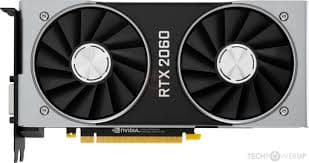
GeForce RTX 2060
GeForce RTX 3050

avg, 1080p
The short answer
The RTX 2060 is the faster card by a wide margin, about 41% ahead of the RTX 3050 at 1080p, and it usually costs less on the used market despite being three years older. The RTX 3050 answers with 8 GB of VRAM against the 2060's 6 GB, lower power draw, and hardware AV1 decode, but none of that closes a 41% frame rate gap. If raw speed and value are what you want, the older card wins clearly.
These two get compared because they sit at nearly the same street price today, even though the RTX 2060 launched in 2019 as a $349 mid-range card and the RTX 3050 launched in 2022 as a $249 entry-level one. On paper the 3050 is the newer architecture, but the 2060 has almost twice the CUDA core count, and that shows up directly in frame rates.
That core-count gap is what the numbers below actually measure: ten-game frame rates with 1% lows, how each card handles ray tracing on DLSS 2, a CPU-pairing check, thermals and power at 160 W versus 130 W, three years of used pricing, and a clear call on which one to buy.
At a glance
Seven dimensions, two cards. Bigger area is not automatically better, each card owns different corners.
Strengths radar
Each axis scored 0-100 relative to the pair
Performance vs price
Up and to the left is better value
Grey dots are neighbouring cards for context.
Which should you buy?
Pick your use case, the winner changes with what you actually do.
41% more frames on average is a real gap at this budget tier, not a rounding error.
The extra core count carries more weight than VRAM at this tier, the 2060 stays the faster pick.
8 GB fits larger models and batches than 6 GB. Capacity beats raw speed for local AI work.
Hardware AV1 decode makes scrubbing and importing modern footage noticeably smoother.
At 130 W and a compact 192mm length, it drops into small cases and 450 W supplies easily.
Wider 192-bit bus and 336 GB/s of bandwidth outrun the 3050's narrower 128-bit bus at high internal resolutions.
Already own an RTX 2060? Don't 'upgrade' to a 3050.
Short answer: probably not
It would be a downgrade in raw frame rate. Despite being the newer architecture, the RTX 3050 is about 41% slower on average because it simply has fewer cores. You would gain 2 GB of VRAM and quieter running, and lose real speed in every game.
If you already own a 2060 and want a genuine step up, look at a used RTX 3060 or RTX 4060, both a real generational jump over either of these cards, not a sideways move.
Full specification comparison
Every spec side by side. The highlighted figure wins each row.
| Specification | RTX 2060 | RTX 3050 |
|---|---|---|
| Architecture | ||
| GPU / architecture | TU106 · Turing | GA106 · Ampere |
| Process node | TSMC 12 nm | Samsung 8 nm ▲ |
| Release date | Jan 15, 2019 | Jan 27, 2022 |
| Launch MSRP | $349 | $249 ▲ |
| Compute | ||
| CUDA cores | 1,920 | 2,560 ▲ |
| RT cores | 30 · 1st gen | 20 · 2nd gen ▲ |
| Tensor cores | 240 · 1st gen | 80 · 3rd gen ▲ |
| Base / boost clock | 1365 / 1680 MHz | 1552 / 1777 MHz ▲ |
| L2 cache | 3 MB ▲ | 2 MB |
| Memory | ||
| VRAM | 6 GB GDDR6 | 8 GB GDDR6 ▲ |
| Memory bus | 192-bit ▲ | 128-bit |
| Bandwidth | 336 GB/s ▲ | 224 GB/s |
| Power & form factor | ||
| TDP | 160 W | 130 W ▲ |
| Power connector | 1× 8-pin | 1× 8-pin |
| Suggested PSU | 500 W | 450 W ▲ |
| PCIe interface | 3.0 ×16 | 4.0 ×8 |
| Features | ||
| Upscaling | DLSS 2 / Super Res | DLSS 2 / Super Res |
| AV1 decode | No | Yes ▲ |
| Display outputs | 3×DP1.4 · HDMI 2.0b · DVI-D | 3×DP1.4a · HDMI 2.1 ▲ |
Average FPS by game
Switch resolution, metric, ray tracing and upscaling, the bars update live. Hover a bar for the avg / 1% / 0.1% breakdown.
Average FPS · 1080p · Rasterization. Representative data, hover a bar for avg / 1% / 0.1%. Note the RTX 3050's 1% lows fall off at 1440p and up from its 8 GB VRAM.
Smoothness & frametimes
Average FPS hides stutter. This is one run plotted as frametime, a flat line is smooth, spikes are hitches. Watch what the RTX 3050's 8 GB VRAM does in a texture-heavy game.
Frametime: Hogwarts Legacy, 1080p Ultra
Lower and flatter is better · 16.7 ms = 60 fps
Counterintuitive but real: the slower RTX 2060 delivers a smoother line here because 12 GB holds the texture pool the 8 GB RTX 3050 keeps evicting, those spikes are VRAM stutter, not raw speed.
Lab scores
Clean apples-to-apples tests, useful, but weaker at predicting real games than the FPS above.
Ray tracing & upscaling
Ray tracing tanks both cards at native resolution. What makes it playable is upscaling, and here the RTX 3050 has a real edge.
Is frame generation "real" performance?
Neither card supports frame generation. DLSS 3 Frame Generation is exclusive to the RTX 40 series and newer, so both the RTX 2060 and RTX 3050 are limited to DLSS 2's Super Resolution upscaling, which raises frame rate by rendering at a lower internal resolution, not by inserting AI-made frames.
If frame generation matters to you, neither card delivers it, you would need at minimum an RTX 4060. Between these two, DLSS 2 image quality is essentially identical, so the deciding factor is which card is fast enough to hit a comfortable base frame rate before upscaling.
Will your CPU bottleneck these cards?
A faster GPU only helps if your CPU keeps up. Pick your CPU and resolution to see expected FPS and bottleneck for each card.
CPU + GPU pairing check
The willitbottleneck engine, built right into the comparison.
Estimated from a 43-CPU model across 1440p. A weak CPU mostly bites at 1080p; at higher resolutions the GPU becomes the limiter and the bottleneck shrinks.
Thermals & noise
The efficiency gap shows up here: the newer card runs cooler and quieter, day in and day out.
Real draw, efficiency & PSU
TDP is the rated figure; what matters is real gaming draw and how many frames you get per watt.
Both use a single 8-pin connector. If your PSU already ran the RTX 2060, it will run the RTX 3050 easily. Leave about 30% headroom for spikes.
Will it fit, and what to pair it with?
Size to scale
Card length matters for small cases
What monitor to pair
RTX 2060: best for 1080p at 100-144 Hz, playable at 1440p 60 Hz in lighter titles. RTX 3050: 1080p at 60-100 Hz is the comfortable zone. Neither is a 1440p-ultra card and 4K is out of reach for both.
Running an older PCIe 3.0 board?
The RTX 3050 runs PCIe 4.0 ×8, which carries roughly the same total bandwidth as the RTX 2060's PCIe 3.0 ×16, so neither loses meaningful performance from its interface on a modern or older motherboard.
Price history & dollars-per-frame
Raw price is only half the story. Cost per frame is the number that decides it, and it keeps moving as prices fall.
New price over time
Street price of new cards (USD)
The 6 GB vs 8 GB question
RTX 2060 · 6 GB
- 6 GB is the tightest budget here, some 2026 AAA titles at 1080p Ultra with ray tracing or high-res texture packs will force a texture setting down.
- 6 GB is still enough for the large majority of esports and older AAA titles at 1080p high to ultra, where this card actually lives.
- The wider 192-bit bus and higher bandwidth mean the memory the 2060 does have works harder per gigabyte than the 3050's narrower bus.
- It is not a safe pick for heavier local AI work or big Blender scenes, 6 GB caps out fast.
RTX 3050 · 8 GB
- 8 GB gives real headroom for 1080p and light 1440p texture packs the 6 GB 2060 cannot hold.
- More comfortable for local Stable Diffusion and small LLM work, where capacity matters more than raw core count.
- The narrower 128-bit bus and lower 224 GB/s bandwidth mean the extra capacity does not translate into extra speed.
- The overall core count is low enough that the 3050 runs out of raw compute before it runs out of memory in most games.
Emulation & memory bandwidth
The narrower bus is a real downgrade for emulation
High-resolution emulation, Switch-style cores and RPCS3 for PS3, leans on memory bandwidth as much as raw shader power. The RTX 2060's 336 GB/s over a 192-bit bus beats the RTX 3050's 224 GB/s over 128-bit, and the 2060's extra CUDA cores help too, so it stays the stronger emulation card despite being the older part.
Creator, AI & streaming
The newer card is quicker per task, but the older card's extra VRAM unlocks larger jobs it can't fit at all.
Streaming: the AV1 encoder is the differentiator
Neither card has a hardware AV1 encoder, that arrived with the RTX 40 series, so both stream and record in H.264 or HEVC through NVENC. The RTX 3050 does add hardware AV1 decode, useful if you edit or watch AV1-encoded footage, but for encoding your own stream the two are close, with the 2060's extra grunt helping in CPU-adjacent encode presets.
Overclocking & undervolting
Both cards have modest overclocking headroom, a few percent at best. The bigger win on either is undervolting for lower temperature and noise, the 160 W RTX 2060 has the most to gain.
Pros & cons
RTX 2060
- 41% faster on average, a real gap not a rounding error
- Wider 192-bit bus and higher bandwidth help at 1440p and in emulation
- Cheapest used option here, best dollars-per-frame by far
- Only 6 GB VRAM, tight for 2026 AAA texture packs
- No AV1 decode, and 160 W runs hotter and louder
RTX 3050
- 8 GB VRAM, more headroom for AI and texture-heavy games
- Lower power draw, fits smaller cases and 450 W supplies
- Hardware AV1 decode and native PCIe 4.0
- 41% slower on average, a real step down in raw speed
- Narrower 128-bit bus limits how far the extra VRAM can help
Buying pitfalls
Which RTX 3050 are you buying?
NVIDIA sold two different desktop RTX 3050 cards, the original 8 GB GA106 part from 2022 and a cut-down 6 GB GA107 version from 2023 that is noticeably slower. This page covers the 8 GB GA106 card, confirm the box says 8 GB and GA106 before you buy.
Laptop chips share the name, not the performance
A laptop RTX 2060 or RTX 3050 is a different, lower-clocked chip than its desktop namesake. Comparing a laptop card against these desktop numbers overstates the laptop's real performance, use the mobile comparison instead.
RTX 2060 vs RTX 3050: your questions answered
In pure frame rate, yes. The RTX 2060 runs about 41% faster on average at 1080p even though it launched three years earlier. The RTX 3050 counters with 2 GB more VRAM, a 30 W lower power draw, and hardware AV1 decode, none of which closes that speed gap.
Get a used RTX 2060 if frame rate per dollar is what matters, it is both faster and typically cheaper secondhand. Pick the RTX 3050 instead if you need a tighter power budget, a smaller card, or the extra 2 GB of VRAM more than you need raw speed.
Plenty. At 1080p the older 2060 still outruns the 3050 by 41%, so its Turing architecture is not the bottleneck. Its 6 GB of VRAM is the part that will show its age first as games grow heavier.
Yes, on capacity. The 3050's 8 GB holds larger Stable Diffusion batches and LLM contexts than the 2060's 6 GB. Neither card is built for serious AI workstation use, but between this pair, the extra memory on the 3050 matters more than the 2060's faster cores.
It is close either way. The 3050's hardware AV1 decode helps when scrubbing or importing modern footage, while the 2060's higher core count gives it an edge in encode-heavy timelines. Neither one has a hardware AV1 encoder, so live streaming quality lands about the same on both.
Both have dedicated RT cores, but ray tracing pushes either card to its limit at this budget tier. Expect to lean on DLSS and drop settings on the 2060 and the 3050 alike, and treat ray tracing as something you turn on occasionally rather than leave running.
No. Both are limited to DLSS 2 Super Resolution upscaling, and image quality between the two is essentially the same since they share that generation of DLSS. Frame generation only arrived with the RTX 40 series, so neither of these cards will ever get it.
Rarely, both sit in the budget tier where a mid-range CPU can keep them fed, especially at 1080p. Check the pairing tool on this page, a Ryzen 5 3600 or Core i5-10400F and anything above is a safe match for either card.
The RTX 3050 pulls less power, around 130 W against the 2060's 160 W, and that shows up as a few degrees cooler and slightly quieter operation. Even so, the 2060 still turns more frames per watt overall, its lead in raw speed outweighs the extra wattage it burns.
Plan on a solid 500 W unit for the RTX 2060 and 450 W for the RTX 3050, each running off a single 8-pin connector. A 550 W supply gives either build room to spare.
The RTX 3050 is the smaller card at roughly 192 mm against the 2060's 229 mm, and both clear the large majority of case size limits. The 3050 runs PCIe 4.0 x8 while the 2060 runs PCIe 3.0 x16, two interfaces that carry almost the same real bandwidth, so neither card loses performance from its slot.
No. Laptop versions of both chips run at lower clocks and lower power than their desktop names suggest, so a laptop 2060 or 3050 falls well short of the numbers on this page. Compare laptop chips against each other separately, not against these desktop figures.
Not comfortably on either one. Both are built for 1080p, with some room for 1440p in lighter games, but 4K asks for more than a 2060 or 3050 can deliver without heavy upscaling and reduced settings.
A used RTX 2060 is the best value on this matchup, just buy from a seller who offers a return window and skip untested ex-mining cards. The RTX 3050 is still sold new, worth considering if a warranty matters more to you than shaving dollars off the price.
Yes, both architectures still have years left in NVIDIA's Game Ready driver cycle. Neither the 2060 nor the 3050 is close to losing driver support before 2030.
No, that swap trades away speed. You would lose about 41% of your frame rate for 2 GB more VRAM and a lighter power draw. Stick with the 2060 unless the smaller card size or the extra memory for AI work outweighs losing that performance.