
RTX 2060 vs GTX 1070
The complete head-to-head: full specs, real per-game FPS with 1% lows, ray tracing, a live CPU-bottleneck check, thermals, power and value, with a straight verdict.
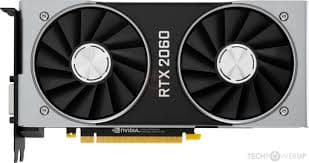
GeForce RTX 2060
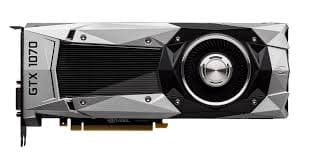
GeForce GTX 1070
avg, 1080p
The short answer
The RTX 2060 is about 15% faster on average and it is the only one of the two with RT cores and Tensor cores for DLSS. The catch is memory: the GTX 1070 carries 8 GB on a 256-bit bus against the 2060's 6 GB on 192-bit, so the older Pascal card holds up better in texture-heavy games, for emulation, and for anything that leans on capacity rather than speed. The two even share the exact same CUDA core count, 1,920, which makes this one of the closer cross-generation matchups on this site.
These two get compared often because they land in the same rough price bracket on the used market and, oddly enough, pack the identical 1,920 CUDA cores. The RTX 2060 is the newer, faster chip with ray tracing and DLSS on top. The GTX 1070 is the older, slightly slower chip with a full 8 GB of VRAM on a wider bus. That memory gap is the real story here, not raw speed.
Because neither card wins outright, weighing the 2060's speed and DLSS against the 1070's extra memory only makes sense game by game, so the numbers below settle it for your specific CPU, resolution, and budget.
At a glance
Seven dimensions, two cards. Bigger area is not automatically better, each card owns different corners.
Strengths radar
Each axis scored 0-100 relative to the pair
Performance vs price
Up and to the left is better value
Grey dots are neighbouring cards for context.
Which should you buy?
Pick your use case, the winner changes with what you actually do.
Faster, has DLSS for extra headroom, and RT support even if you rarely use it.
8 GB on a 256-bit bus avoids the texture stutter the 6 GB 2060 can hit at higher settings.
Tensor cores accelerate AI workloads directly; the 1070's extra 2 GB doesn't make up for having none.
Turing's NVENC adds HEVC B-frame support, a real quality-per-bitrate gain Pascal's encoder lacks.
10 W lower TDP than the 2060, though neither card is especially demanding on a modern PSU.
The extra VRAM capacity matters more than raw bandwidth once you push internal resolution and texture packs up.
Already own a GTX 1070? A 2060 is a sidegrade, not a clear upgrade.
Short answer: probably not
A 15% average gain while losing 2 GB of VRAM is not an obvious win if you already own a 1070. You would mainly be paying for RT cores and DLSS, features that matter only if you actually plan to use them, and for a newer NVENC encoder if you stream.
If VRAM headroom matters more to you than raw speed, keep the 1070. If you want a real, unambiguous upgrade, aim for a used RTX 3060, which adds DLSS 2 that actually performs, 12 GB of memory, and a healthy jump in raw speed over both of these cards.
Full specification comparison
Every spec side by side. The highlighted figure wins each row.
| Specification | RTX 2060 | GTX 1070 |
|---|---|---|
| Architecture | ||
| GPU / architecture | TU106-200A · Turing | GP104-200 · Pascal |
| Process node | TSMC 12nm FFN ▲ | TSMC 16nm FinFET |
| Release date | Jan 15, 2019 | Jun 10, 2016 |
| Launch MSRP | $349 ▲ | $379 |
| Compute | ||
| CUDA cores | 1,920 | 1,920 |
| RT cores | 30 · 1st gen ▲ | None |
| Tensor cores | 240 · 1st gen ▲ | None |
| Base / boost clock | 1365 / 1680 MHz | 1506 / 1683 MHz ▲ |
| L2 cache | 3 MB ▲ | 2 MB |
| Memory | ||
| VRAM | 6 GB GDDR6 | 8 GB GDDR5 ▲ |
| Memory bus | 192-bit | 256-bit ▲ |
| Bandwidth | 336 GB/s ▲ | 256 GB/s |
| Power & form factor | ||
| TDP | 160 W | 150 W ▲ |
| Power connector | 1× 8-pin | 1× 8-pin |
| Suggested PSU | 500 W | 500 W |
| PCIe interface | 3.0 ×16 | 3.0 ×16 |
| Features | ||
| Upscaling | DLSS 2 / Super Res + FSR ▲ | FSR / NIS only, no DLSS |
| AV1 encode (NVENC) | No | No |
| Display outputs | 3×DP1.4 · HDMI 2.0b | 3×DP1.4 · HDMI 2.0b · DVI-D |
Average FPS by game
Switch resolution, metric, ray tracing and upscaling, the bars update live. Hover a bar for the avg / 1% / 0.1% breakdown.
Average FPS · 1080p · Rasterization. Representative data, hover a bar for avg / 1% / 0.1%. Note the GTX 1070's 1% lows fall off at 1440p and up from its 8 GB VRAM.
Smoothness & frametimes
Average FPS hides stutter. This is one run plotted as frametime, a flat line is smooth, spikes are hitches. Watch what the GTX 1070's 8 GB VRAM does in a texture-heavy game.
Frametime: Starfield, 1080p Ultra
Lower and flatter is better · 16.7 ms = 60 fps
Counterintuitive but real: the slower RTX 2060 delivers a smoother line here because 12 GB holds the texture pool the 8 GB GTX 1070 keeps evicting, those spikes are VRAM stutter, not raw speed.
Lab scores
Clean apples-to-apples tests, useful, but weaker at predicting real games than the FPS above.
Ray tracing & upscaling
Ray tracing tanks both cards at native resolution. What makes it playable is upscaling, and here the GTX 1070 has a real edge.
Is frame generation "real" performance?
Neither card supports DLSS 3 Frame Generation, that needs the Optical Flow Accelerator hardware NVIDIA introduced with RTX 40-series. The RTX 2060's DLSS is limited to Super Resolution upscaling, and the GTX 1070 predates Tensor cores entirely, so it has no DLSS of any kind.
AMD's FSR 3 Frame Generation works on both since it isn't hardware-locked, so that is the only frame-gen option either card has. It smooths the counter at some latency cost, keep it to single-player games and don't rely on it below roughly 50 base fps.
Will your CPU bottleneck these cards?
A faster GPU only helps if your CPU keeps up. Pick your CPU and resolution to see expected FPS and bottleneck for each card.
CPU + GPU pairing check
The willitbottleneck engine, built right into the comparison.
Estimated from a 43-CPU model across 1440p. A weak CPU mostly bites at 1080p; at higher resolutions the GPU becomes the limiter and the bottleneck shrinks.
Thermals & noise
The efficiency gap shows up here: the newer card runs cooler and quieter, day in and day out.
Real draw, efficiency & PSU
TDP is the rated figure; what matters is real gaming draw and how many frames you get per watt.
Both use a single 8-pin connector. If your PSU already ran the RTX 2060, it will run the GTX 1070 easily. Leave about 30% headroom for spikes.
Will it fit, and what to pair it with?
Size to scale
Card length matters for small cases
What monitor to pair
GTX 1070: 1080p at 100-144 Hz, or 1440p at 60 Hz on most titles. RTX 2060: much the same range, slightly ahead, with light DLSS headroom in supported games. Neither is a strong 1440p-Ultra card by 2026 standards.
Running an older PCIe 3.0 board?
The RTX 2060 and GTX 1070 both interface at PCIe 3.0 ×16, so neither gives up anything to the other there. Drop either into a newer PCIe 4.0 or 5.0 board and it performs the same, since a card in this performance class never gets close to saturating even a 3.0 ×8 link.
Price history & dollars-per-frame
Raw price is only half the story. Cost per frame is the number that decides it, and it keeps moving as prices fall.
New price over time
Street price of new cards (USD)
The 6 GB vs 8 GB question
RTX 2060 · 6 GB
- 336 GB/s of bandwidth and 3 MB of L2 cache soften the effect of the smaller 6 GB pool somewhat.
- Tensor cores make local AI tools that fit in 6 GB noticeably faster than on the memory-only advantage of the 1070.
- 8 GB is quickly becoming the practical floor for 1080p Ultra with texture packs, and the 2060 falls 2 GB short of that.
- Emulator cores that scale internal resolution aggressively can hit the 6 GB ceiling before the 1070 hits its 8 GB one.
GTX 1070 · 8 GB
- 8 GB on a 256-bit bus is still a comfortable amount for 1080p and light 1440p gaming in 2026.
- The extra capacity helps most in emulation and in games that load large uncompressed texture packs.
- 256 GB/s of bandwidth is lower than the 2060's 336 GB/s, so the extra capacity doesn't always translate into extra speed.
- No Tensor cores at all, so there is no DLSS fallback and AI workloads run on general compute only.
Emulation & memory bandwidth
The narrower bus is a real downgrade for emulation
This is close. The RTX 2060 has more raw bandwidth, 336 GB/s against 256 GB/s, which helps at moderate internal resolutions. But the GTX 1070's 8 GB gives it more room before it runs out of memory entirely, and in RPCS3 or high-resolution Switch emulation with heavy texture packs, running out of VRAM causes far worse stutter than running short on bandwidth. For the heaviest emulation workloads, the 1070's extra capacity is usually the more useful advantage.
Creator, AI & streaming
The newer card is quicker per task, but the older card's extra VRAM unlocks larger jobs it can't fit at all.
Streaming: the AV1 encoder is the differentiator
The RTX 2060 has the newer NVENC implementation, and Turing specifically added HEVC B-frame support that Pascal's encoder lacks, a real, visible gain in quality at the same bitrate. For anyone streaming or archiving footage in HEVC, that difference is worth having. Neither card has an AV1 encoder.
Overclocking & undervolting
Pascal has real overclocking headroom, often 10-15% with a solid cooler, while Turing's RTX 2060 is more modest at 5-8%. If you like to tune manually, the 1070 rewards the effort more; if you'd rather set and forget, undervolt the 2060 instead.
Pros & cons
RTX 2060
- Only card here with RT cores and Tensor cores for DLSS
- About 15% faster on average across modern titles
- Newer NVENC encoder with HEVC B-frame support
- 6 GB VRAM, 2 GB less than the GTX 1070
- Costs more on the used market
GTX 1070
- 8 GB VRAM on a wide 256-bit bus
- Cheaper on the used market, best $/frame of the two
- Strong overclocking headroom, typically 10-15%
- No RT cores or DLSS, stuck with FSR/NIS upscaling
- About 15% slower on average
- Older NVENC without HEVC B-frame support
Buying pitfalls
Which RTX 2060 are you buying?
A rare 2021 re-release used a 12 GB GDDR6 configuration with 2,176 CUDA cores instead of the original 1,920-core, 6 GB card. Check the box or a GPU-Z readout before buying used, it is a meaningfully different card from the one on this page.
GTX 1070 vs GTX 1070 Ti, they are not the same card
The 1070 Ti has 2,432 CUDA cores and GDDR5X memory, a real step up from the plain 1070's 1,920 cores and GDDR5. Used listings mix them up constantly, confirm the exact model before you buy.
RTX 2060 vs GTX 1070: your questions answered
The RTX 2060 does on speed, roughly 15% ahead on average, and it is the only one with RT cores and DLSS. The GTX 1070 answers back with 8 GB of VRAM on a 256-bit bus against the 2060's 6 GB on 192-bit, so it holds the edge in texture-heavy and emulation workloads.
Go with the 2060 for the faster card with DLSS and some ray tracing capability. Go with the 1070 if 1440p or emulation headroom from extra VRAM matters more to you than raw speed, or if you want the cheaper used price.
Both still handle 1080p at medium to high settings without trouble. Neither the 2060 nor the 1070 is built for demanding modern AAA titles at Ultra, so treat them as budget or backup cards at this point.
Not really. The jump is about 15% average speed plus DLSS, but you give up 2 GB of VRAM in the trade. If you own a 1070 already, put the money toward a used RTX 3060 instead for a cleaner upgrade.
The RTX 2060, since its Tensor cores accelerate those workloads in hardware. The GTX 1070's extra 2 GB of memory doesn't offset having no dedicated AI hardware at all.
The RTX 2060. Turing's NVENC encoder added HEVC B-frame support that Pascal's encoder in the 1070 never got, and that shows up as a visible quality gain at matching bitrates.
Only the RTX 2060, through its 30 RT cores and 240 Tensor cores running DLSS Super Resolution. The GTX 1070 launched before either technology existed and has no equivalent hardware.
Neither can. That needs the Optical Flow Accelerator NVIDIA added starting with RTX 40-series. AMD's FSR 3 Frame Generation isn't hardware-locked, so it's the frame-gen path open to both of these cards instead.
Less than you'd think, since both sit at a modest performance tier. A Ryzen 5 3600 or Core i5-10400F or newer keeps either card fed at 1080p; run the pairing checker above with your exact CPU to confirm.
Close: 160 W rated for the 2060 against 150 W for the 1070. In practice the 2060's newer, more efficient process node lets it run a bit cooler and quieter under the same load.
500 W handles either card without issue. Stepping up to 550-650 W buys headroom if a CPU or GPU upgrade is in your future.
The 2060 is the shorter card at 229 mm; a reference GTX 1070 stretches to 267 mm, so measure your case before buying the 1070 specifically. Both use PCIe 3.0 ×16 and run identically on a newer 4.0 or 5.0 board.
Yes, both were sold in mobile form at lower clocks and power limits than the desktop cards covered on this page, so don't apply these desktop numbers to a laptop carrying the same name.
Not for current AAA games. Both are built for 1080p, with the 2060 stretching into 1440p on lighter titles. Neither is a sensible 4K pick in 2026.
The 1070 edges it on raw dollars, around $65 used against $75 for the 2060. Pay the extra for the 2060 only if DLSS or ray tracing, even in a limited form, is worth it to you.
Both still receive NVIDIA Game Ready drivers, with the Turing-based 2060 positioned more comfortably than the older Pascal-based 1070. Neither will pick up new architecture-level driver features going forward.