
GTX 1660 vs GTX 1070
The complete head-to-head: full specs, real per-game FPS with 1% lows, ray tracing, a live CPU-bottleneck check, thermals, power and value, with a straight verdict.
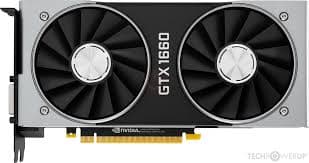
GeForce GTX 1660
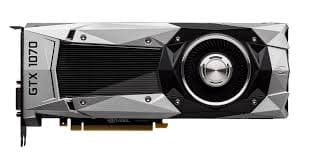
GeForce GTX 1070
avg, 1080p
The short answer
These trade blows more than the release dates suggest. The GTX 1070, despite being three years older, stays about 9% ahead on average thanks to more CUDA cores, more VRAM, and more bandwidth. The GTX 1660 counters with a newer, more efficient architecture, a noticeably higher boost clock, cooler running temperatures, and a real edge in dollars per frame. If both are similarly priced, the 1070's extra memory and bandwidth make it the safer long-term pick. If the 1660 is meaningfully cheaper, it's close enough not to matter much.
These two land close enough in price and performance that the release date order almost doesn't matter. The GTX 1070 came first, in 2016, with a bigger, more powerful Pascal chip and 8 GB of VRAM. The GTX 1660 arrived three years later on the newer, more efficient Turing architecture, but NVIDIA priced and positioned it a tier below the 1070, so it never quite catches up in raw specs.
Ahead: 1080p frame rate results for both cards, thermal and power comparisons, a CPU pairing tool, price trends since 2023, and a verdict aimed at the used market where these two constantly cross paths.
At a glance
Seven dimensions, two cards. Bigger area is not automatically better, each card owns different corners.
Strengths radar
Each axis scored 0-100 relative to the pair
Performance vs price
Up and to the left is better value
Grey dots are neighbouring cards for context.
Which should you buy?
Pick your use case, the winner changes with what you actually do.
Cheaper both new-ish and used, and it beats the 1070 on dollars per frame despite being slightly slower.
8 GB and 256 GB/s of bandwidth give the 1070 real headroom the 1660's 6 GB and 192 GB/s don't have.
Neither has Tensor Cores, but the 1070's extra 2 GB of VRAM fits larger models and batches.
The 1660's newer Turing encoder is a genuine step up in quality over the 1070's older Pascal encoder.
Lower temps and less noise under load, plus idle fan-stop, make the 1660 the easier card to live with.
Pascal's legendary OC headroom gives the 1070 more free performance to chase than the 1660's smaller ceiling.
Already own one of these? A 9% gap isn't worth chasing either way.
Short answer: probably not
If you own a 1660 and are eyeing a 1070, or vice versa, the real-world difference is small enough that it's not worth spending money to switch. Save that money toward something that's an actual step up.
For a genuine upgrade from either card, look at an RTX 3050 or RTX 3060, both add real ray tracing and DLSS on top of a meaningful speed jump, something neither of these older cards can offer.
Full specification comparison
Every spec side by side. The highlighted figure wins each row.
| Specification | GTX 1660 | GTX 1070 |
|---|---|---|
| Architecture | ||
| GPU / architecture | TU116 · Turing | GP104 · Pascal |
| Process node | TSMC 12 nm ▲ | TSMC 16 nm |
| Release date | Mar 14, 2019 | Jun 10, 2016 |
| Launch MSRP | $219 ▲ | $379 |
| Compute | ||
| CUDA cores | 1,408 | 1,920 ▲ |
| RT cores | None | None |
| Tensor cores | None | None |
| Base / boost clock | 1530 / 1785 MHz ▲ | 1506 / 1683 MHz |
| L2 cache | 1.5 MB | 2 MB ▲ |
| Memory | ||
| VRAM | 6 GB GDDR5 | 8 GB GDDR5 ▲ |
| Memory bus | 192-bit | 256-bit ▲ |
| Bandwidth | 192 GB/s | 256 GB/s ▲ |
| Power & form factor | ||
| TDP | 120 W ▲ | 150 W |
| Power connector | 1× 8-pin | 1× 8-pin |
| Suggested PSU | 450 W ▲ | 500 W |
| PCIe interface | 3.0 ×16 | 3.0 ×16 |
| Features | ||
| Upscaling | FSR 2 (no DLSS) | FSR 2 (no DLSS) |
| AV1 encode (NVENC) | No | No |
| Display outputs | 3×DP1.4 · HDMI2.0b | 3×DP1.4 · HDMI2.0b · DL-DVI-D |
Average FPS by game
Switch resolution, metric, ray tracing and upscaling, the bars update live. Hover a bar for the avg / 1% / 0.1% breakdown.
Average FPS · 1080p · Rasterization. Representative data, hover a bar for avg / 1% / 0.1%. Note the GTX 1070's 1% lows fall off at 1440p and up from its 8 GB VRAM.
Smoothness & frametimes
Average FPS hides stutter. This is one run plotted as frametime, a flat line is smooth, spikes are hitches. Watch what the GTX 1070's 8 GB VRAM does in a texture-heavy game.
Frametime: Hogwarts Legacy, 1080p Ultra
Lower and flatter is better · 16.7 ms = 60 fps
Counterintuitive but real: the slower GTX 1660 delivers a smoother line here because 12 GB holds the texture pool the 8 GB GTX 1070 keeps evicting, those spikes are VRAM stutter, not raw speed.
Lab scores
Clean apples-to-apples tests, useful, but weaker at predicting real games than the FPS above.
Ray tracing & upscaling
Ray tracing tanks both cards at native resolution. What makes it playable is upscaling, and here the GTX 1070 has a real edge.
Is frame generation "real" performance?
Neither card supports DLSS Frame Generation, that needs Tensor Cores plus the Optical Flow Accelerator that only arrived with RTX 40-series. The GTX 1660 has no Tensor Cores at all, Turing's non-RTX cards skipped them, and the GTX 1070 predates DLSS entirely.
AMD's FSR 2 and FSR 3 are the closest options for either card, both open and non-AI so they run through the game engine rather than fixed hardware. Neither card gets true frame generation.
Will your CPU bottleneck these cards?
A faster GPU only helps if your CPU keeps up. Pick your CPU and resolution to see expected FPS and bottleneck for each card.
CPU + GPU pairing check
The willitbottleneck engine, built right into the comparison.
Estimated from a 43-CPU model across 1440p. A weak CPU mostly bites at 1080p; at higher resolutions the GPU becomes the limiter and the bottleneck shrinks.
Thermals & noise
The efficiency gap shows up here: the newer card runs cooler and quieter, day in and day out.
Real draw, efficiency & PSU
TDP is the rated figure; what matters is real gaming draw and how many frames you get per watt.
Both use a single 8-pin connector. If your PSU already ran the GTX 1660, it will run the GTX 1070 easily. Leave about 30% headroom for spikes.
Will it fit, and what to pair it with?
Size to scale
Card length matters for small cases
What monitor to pair
GTX 1660: solid 1080p ultra at 60 to 100 Hz. GTX 1070: similar 1080p performance with a bit more headroom into 1440p thanks to the extra VRAM and bandwidth. Neither is a realistic 4K card in 2026.
Running an older PCIe 3.0 board?
Both cards run a full PCIe 3.0 x16 link, so motherboard generation doesn't matter for either. Neither comes close to saturating even a PCIe 3.0 x8 link, let alone x16.
Price history & dollars-per-frame
Raw price is only half the story. Cost per frame is the number that decides it, and it keeps moving as prices fall.
New price over time
Street price of new cards (USD)
The 6 GB vs 8 GB question
GTX 1660 · 6 GB
- 6 GB covers the large majority of 1080p games at high to ultra settings in 2026.
- Newer Turing architecture makes more efficient use of its memory bandwidth than the 1070's older Pascal design.
- 2 GB less than the 1070, the first thing that runs out in newer, texture-heavy titles.
- 192 GB/s bandwidth trails the 1070's 256 GB/s, a real gap at 1440p.
GTX 1070 · 8 GB
- 8 GB on a full 256-bit bus gives real headroom over the 1660's 6 GB, especially at 1440p.
- 256 GB/s of bandwidth, the highest of any card in this comparison.
- Enough capacity for small local AI models and large creator scenes the 1660 can't comfortably hold.
- Older Pascal architecture uses that bandwidth less efficiently than Turing per byte moved.
Emulation & memory bandwidth
The narrower bus is a real downgrade for emulation
The GTX 1070's 256 GB/s bandwidth and 8 GB of VRAM outperform the 1660's 192 GB/s and 6 GB for emulators like Yuzu-style Switch cores and RPCS3, especially once you push internal resolution scaling above 2x. For dedicated emulation use, the 1070 is the stronger pick despite its age.
Creator, AI & streaming
The newer card is quicker per task, but the older card's extra VRAM unlocks larger jobs it can't fit at all.
Streaming: the AV1 encoder is the differentiator
Neither has an AV1 encoder. Both fall back to H.264/HEVC through NVENC. The 1660's Turing-generation encoder is a genuine step up in quality per bitrate over the 1070's older Pascal encoder, a rare case where the slower card streams cleaner.
Overclocking & undervolting
The GTX 1070 has the bigger overclocking ceiling of the two, Pascal is famous for scaling cleanly past its stock boost clock with a simple power limit increase. The GTX 1660 overclocks predictably too, but Turing's non-RTX cards left less on the table from the factory, so gains are smaller.
Pros & cons
GTX 1660
- Cheaper both new-ish and used, and better dollars-per-frame
- Newer, more efficient Turing architecture runs cooler and quieter
- Better NVENC encoder for streaming despite being the older card here
- About 9% slower on average across this test suite
- 6 GB and 192 GB/s trail the 1070's 8 GB and 256 GB/s
GTX 1070
- About 9% faster with more VRAM headroom for 1440p
- 256 GB/s of bandwidth, the most of any card in this comparison
- Legendary Pascal overclocking headroom for extra free performance
- Costs noticeably more on both the new-ish and used markets
- Higher 150 W draw needs an 8-pin connector and a beefier PSU
Buying pitfalls
This is closer than a 9% gap usually plays out
The GTX 1070's lead comes mostly from bandwidth and VRAM, not raw shader power, the 1660 actually has fewer CUDA cores but a newer, more efficient architecture. In lighter or newer titles the 1660 sometimes catches up or slightly leads, check reviews for the specific games you play.
Reference vs custom cooler matters on a card this old
Most surviving GTX 1070s are Founders Edition or reference blower-cooled cards, which run hotter and louder than an aftermarket triple-fan 1660. Factor in which cooler you're actually buying, the thermal numbers above assume decent, non-blower cooling on both.
GTX 1660 vs GTX 1070: your questions answered
It helps close the gap, yes. The 1070 is about 9% faster on average with more VRAM and bandwidth. The GTX 1660 counters with lower power draw, cooler temps, and a better price per frame. This is a genuinely close comparison.
If they're priced similarly, buy the 1070 for the extra VRAM and bandwidth headroom at 1440p. If the 1660 is meaningfully cheaper, it's close enough in performance that the savings are worth it.
Yes, both remain solid 1080p cards, and the 1070 stretches into light 1440p. Neither has ray tracing or DLSS, so newer titles that lean on those features will look and run better on a modern card.
A little, its extra VRAM fits somewhat larger models and batches than the 1660's 6 GB. Neither has Tensor Cores though, so both are slow next to any modern RTX card for serious AI work.
For streaming quality, yes, the 1660's newer Turing encoder produces cleaner video at the same bitrate than the 1070's older Pascal encoder. For large editing timelines, the 1070's extra VRAM and bandwidth help more.
Completely. Both are pre-RTX designs with no dedicated RT cores. Ray tracing only runs through slow software fallback, effectively unusable on either card.
Not DLSS, that needs Tensor Cores which neither card has. Both work with AMD's open FSR 2 and FSR 3 upscalers instead, since those run on any GPU.
Somewhat, both are modest by 2026 standards, so most CPUs from the last several years keep them fed at 1080p without bottlenecking. Use the pairing checker on this page to confirm your exact CPU.
The GTX 1660, it draws about 112 W and runs noticeably cooler and quieter than the GTX 1070's roughly 145 W, which also tends to come on louder reference coolers.
NVIDIA recommends 450 W for the GTX 1660 and 500 W for the GTX 1070. A quality 550 W unit comfortably covers either card.
Yes, around 229mm for the 1660 and 267mm for a typical 1070, check your case's clearance before buying. Both run a full PCIe 3.0 x16 link, so motherboard generation isn't a factor for either.
No. GTX 1660 Ti Mobile (the non-Ti 1660 had limited mobile presence) and GTX 1070 Mobile, including a Max-Q variant, both run at lower clocks and power limits than these desktop parts, never compare them directly.
Only 1440p, and only a little. Both are 1080p cards at heart, with the 1070 stretching a bit further into 1440p. Treat 4K as unrealistic for this pairing.
Yes, in 2026. Buy from a seller with a return window, avoid untested ex-mining cards, and expect to pay in the $65 to $120 range depending on which card and condition.
Neither immediately, NVIDIA continues Game Ready driver support for both architectures, so neither is at real risk of losing updates, though don't expect either to be a priority for new game optimizations going forward.
NVIDIA positioned the 1660 as a cheaper, lower tier than the 1070 originally was, fewer CUDA cores and a narrower memory bus, even though it uses a newer architecture. Newer doesn't automatically mean faster once pricing tiers are factored in.