
RTX 3090 vs RTX 4090
The complete head-to-head: full specs, real per-game FPS with 1% lows, ray tracing, a live CPU-bottleneck check, thermals, power and value, with a straight verdict.
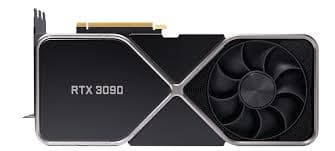
GeForce RTX 3090
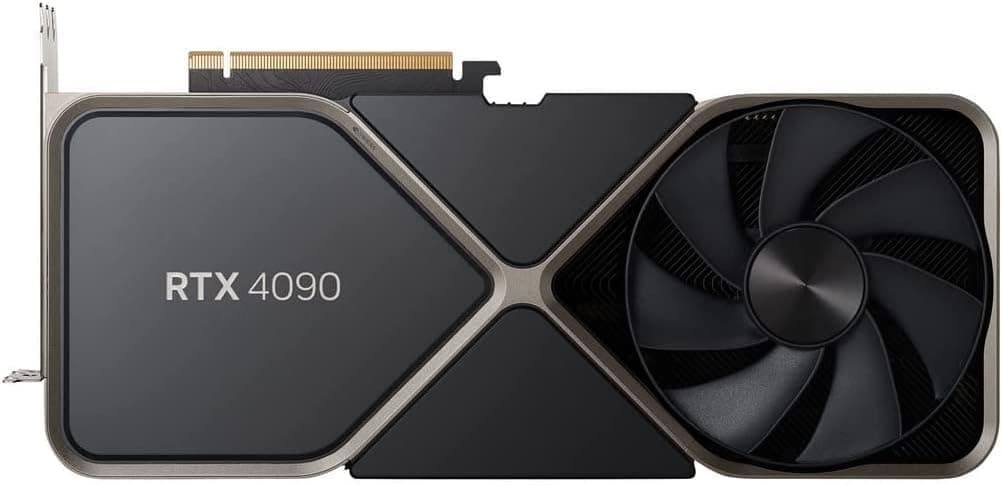
GeForce RTX 4090
avg, 1080p
The short answer
The RTX 4090 is comfortably the faster card, about 45% ahead on average at 1080p ultra and further ahead still at 4K. Both cards carry the same 24 GB of VRAM, so this is not a memory argument the way most cross-gen matchups are, it is a straight compute and bandwidth gap. The catch is price. A used 3090 now costs less than half of a used 4090, and on cost per frame the older card actually wins. Buy the 4090 if you want the fastest card money can buy today. Buy the 3090 if you want 24 GB and strong 4K performance for a fraction of the cost.
These are two 24 GB flagships from consecutive NVIDIA generations, which makes this an unusual matchup: it is not a VRAM argument like most cross-gen comparisons, both cards carry the exact same capacity. What separates them is architecture, clock speed, and memory bandwidth, and Ada simply has more of all three. The question is whether that 45% gap is worth roughly double the money at current street prices.
The numbers ahead cover all ten benchmarked games with 1% lows, ray tracing and Frame Generation results, a live CPU-pairing check, thermal and power figures, and three years of pricing data, enough to weigh that 45% speed gap against the roughly $800 price difference yourself.
At a glance
Seven dimensions, two cards. Bigger area is not automatically better, each card owns different corners.
Strengths radar
Each axis scored 0-100 relative to the pair
Performance vs price
Up and to the left is better value
Grey dots are neighbouring cards for context.
Which should you buy?
Pick your use case, the winner changes with what you actually do.
A real 45% average lead, and the only one of the two that holds 4K above 60 fps in the heaviest titles without upscaling.
At 1080p and 1440p the 3090 is rarely the bottleneck, so the 4090's extra speed goes mostly unused while you pay nearly triple.
Both hold 24 GB, so the 4090's newer 4th-gen Tensor cores and far higher throughput make it the clear pick once budget allows.
Dual AV1 hardware encoders and a faster NVENC pipeline cut export times hard, the 3090 has no AV1 encoder at all.
A 45% gain does not justify replacing a 350 W, 24 GB card that still plays everything at 1440p and most of 4K.
Neither card is challenged by emulation or older titles at these bandwidths, so the 3090 handles it just as well for far less money.
Already own an RTX 3090? Only upgrade if you actually need the speed.
Short answer: probably not
A 45% average gain is real, but you would be spending roughly $800 more at street prices to get it, and you would not gain any VRAM in the process, both cards sit at 24 GB. If your games and workloads already run well, the 3090 is not holding you back the way an 8 GB card would.
The upgrade makes sense if you are GPU-bound at 4K with ray tracing on, if you need DLSS 3 Frame Generation, or if AI and rendering throughput is your job and time saved pays for the card. Otherwise, keep the 3090 and let the 4090's price fall further, or wait for its RTX 50-series successor.
Full specification comparison
Every spec side by side. The highlighted figure wins each row.
| Specification | RTX 3090 | RTX 4090 |
|---|---|---|
| Architecture | ||
| GPU / architecture | GA102 · Ampere | AD102 · Ada |
| Process node | Samsung 8 nm | TSMC 4N (5 nm) ▲ |
| Release date | Sep 24, 2020 | Oct 12, 2022 |
| Launch MSRP | $1,499 ▲ | $1,599 |
| Compute | ||
| CUDA cores | 10,496 | 16,384 ▲ |
| RT cores | 82 · 2nd gen | 128 · 3rd gen ▲ |
| Tensor cores | 328 · 3rd gen | 512 · 4th gen ▲ |
| Base / boost clock | 1395 / 1695 MHz | 2235 / 2520 MHz ▲ |
| L2 cache | 6 MB | 72 MB ▲ |
| Memory | ||
| VRAM | 24 GB GDDR6X | 24 GB GDDR6X |
| Memory bus | 384-bit | 384-bit |
| Bandwidth | 936 GB/s | 1,008 GB/s ▲ |
| Power & form factor | ||
| TDP | 350 W ▲ | 450 W |
| Power connector | 2× 8-pin | 1× 16-pin (12VHPWR) |
| Suggested PSU | 750 W ▲ | 850 W |
| PCIe interface | 4.0 ×16 | 4.0 ×16 |
| Features | ||
| Upscaling | DLSS 2 / Super Res | DLSS 4 + Frame Gen ▲ |
| AV1 encode (NVENC) | No | Yes · dual encoder ▲ |
| Display outputs | 3×DP1.4a · HDMI 2.1 | 3×DP1.4a · HDMI 2.1 |
Average FPS by game
Switch resolution, metric, ray tracing and upscaling, the bars update live. Hover a bar for the avg / 1% / 0.1% breakdown.
Average FPS · 1080p · Rasterization. Representative data, hover a bar for avg / 1% / 0.1%. Note the RTX 4090's 1% lows fall off at 1440p and up from its 8 GB VRAM.
Smoothness & frametimes
Average FPS hides stutter. This is one run plotted as frametime, a flat line is smooth, spikes are hitches. Watch what the RTX 4090's 8 GB VRAM does in a texture-heavy game.
Frametime: Alan Wake 2, 4K Ultra + Ray Tracing
Lower and flatter is better · 16.7 ms = 60 fps
Counterintuitive but real: the slower RTX 3090 delivers a smoother line here because 12 GB holds the texture pool the 8 GB RTX 4090 keeps evicting, those spikes are VRAM stutter, not raw speed.
Lab scores
Clean apples-to-apples tests, useful, but weaker at predicting real games than the FPS above.
Ray tracing & upscaling
Ray tracing tanks both cards at native resolution. What makes it playable is upscaling, and here the RTX 4090 has a real edge.
Is frame generation "real" performance?
The RTX 3090 predates DLSS 3 entirely, Ampere has no Frame Generation hardware, so it is stuck with real, rendered frames only. The RTX 4090 supports DLSS 3 single Frame Generation, which inserts an AI-made frame between two real ones. Motion looks smoother on a high-refresh 4K panel, and the counter can nearly double, but those inserted frames do not react to input, so latency rises slightly. NVIDIA Reflex claws most of it back.
On the 4090, use Frame Generation for single-player and cinematic games at 4K, especially with ray tracing on, and skip it for competitive shooters or when your base frame rate is under about 50 fps. The 4090 does not get DLSS 4's Multi Frame Generation, that stays exclusive to the RTX 50 series, but single Frame Gen alone is still a meaningful boost the 3090 simply cannot match.
Will your CPU bottleneck these cards?
A faster GPU only helps if your CPU keeps up. Pick your CPU and resolution to see expected FPS and bottleneck for each card.
CPU + GPU pairing check
The willitbottleneck engine, built right into the comparison.
Estimated from a 43-CPU model across 1440p. A weak CPU mostly bites at 1080p; at higher resolutions the GPU becomes the limiter and the bottleneck shrinks.
Thermals & noise
The efficiency gap shows up here: the newer card runs cooler and quieter, day in and day out.
Real draw, efficiency & PSU
TDP is the rated figure; what matters is real gaming draw and how many frames you get per watt.
Both use a single 8-pin connector. If your PSU already ran the RTX 3090, it will run the RTX 4090 easily. Leave about 30% headroom for spikes.
Will it fit, and what to pair it with?
Size to scale
Card length matters for small cases
What monitor to pair
RTX 3090: 4K at 60-100 Hz on most titles, 1440p at 144 Hz and up without much thought. RTX 4090: 4K at 100-144 Hz in the majority of games, and it is one of the few consumer cards that can meaningfully drive a 4K 240 Hz panel or a 5K2K ultrawide without leaning on upscaling constantly.
Running an older PCIe 3.0 board?
Both cards use a full PCIe 4.0 ×16 link, and neither is meaningfully starved by it. Even on a PCIe 3.0 ×16 board the loss is under 5% for either card. Neither supports PCIe 5.0, but at this performance tier that would not matter yet either way.
Price history & dollars-per-frame
Raw price is only half the story. Cost per frame is the number that decides it, and it keeps moving as prices fall.
New price over time
Street price of new cards (USD)
The 24 GB vs 24 GB question
RTX 3090 · 24 GB
- 24 GB is still enough for any 2026 game at 4K max settings, and for most local LLM and Stable Diffusion checkpoints.
- 936 GB/s across a 384-bit bus keeps that memory fed well even by current standards.
- For pure VRAM capacity per dollar, especially used, nothing in this matchup beats the 3090.
- The compute behind the memory is a full generation behind, so the 3090 cannot always process what its 24 GB holds as quickly as the 4090 can.
RTX 4090 · 24 GB
- Same 24 GB capacity as the 3090, but 1,008 GB/s of bandwidth and a much larger 72 MB L2 cache put it to work faster.
- Less stutter in texture streaming and quicker AI batch processing at the same 24 GB ceiling.
- 24 GB plus Ada's throughput handles serious local LLM and diffusion work without compromise.
- You are not getting more capacity than the 3090, just a faster path to the same 24 GB, an expensive upgrade if capacity was never the bottleneck.
Emulation & memory bandwidth
The narrower bus is a real downgrade for emulation
Both cards have far more bandwidth and VRAM than any current emulator needs, so this is not the bandwidth-limited situation that shows up in lower-tier matchups. High-resolution Switch, PS3, and Wii U emulation, and demanding shader-heavy cores, scale directly with raw compute here, which means the RTX 4090's speed advantage carries straight through. Neither card is memory-limited in this use case.
Creator, AI & streaming
The newer card is quicker per task, but the older card's extra VRAM unlocks larger jobs it can't fit at all.
Streaming: the AV1 encoder is the differentiator
The RTX 4090 packs dual AV1 hardware encoders and a faster NVENC pipeline, exports finish noticeably quicker and simultaneous encode-plus-render workloads barely dent frame rate. The RTX 3090 has no AV1 encoder at all, it is limited to H.264 and HEVC, still usable but a clear step behind for anyone streaming or exporting AV1-aware content regularly.
Overclocking & undervolting
Both chips already run close to their factory limits. Undervolting is the better lever on either card, especially the 4090, where a 90-100 W reduction is possible for only a few percent lost performance.
Pros & cons
RTX 3090
- 24 GB VRAM at a fraction of the 4090's price, especially used
- Still handles 4K and any current game competently
- Lower PSU requirement (750 W vs 850 W) and a simpler 8-pin power setup
- About 45% slower on average, and the gap widens in path-traced titles
- No DLSS 3 Frame Generation, no DLSS 4 upscaling, and no AV1 encoder
RTX 4090
- Dramatically faster across gaming, AI, and rendering alike, with the same 24 GB as the 3090
- DLSS 3 Frame Generation, DLSS 4 upscaling, and dual AV1 encoders
- Best-in-class thermals for its power draw thanks to a large, well-engineered cooler
- Costs more than double the 3090 at street price, and loses on cost per frame
- 450 W draw and the 16-pin connector demand a higher-end PSU and careful cable routing
Buying pitfalls
The 4090's 12VHPWR connector needs care
The RTX 4090's 16-pin 12VHPWR connector has a documented history of overheating when not fully seated or when bent sharply near the plug. Push it in until it clicks, avoid tight bends in the first few inches of cable, and prefer a native 12VHPWR PSU cable over an adapter where possible.
Used 3090s can have hot memory
Early RTX 3090 Founders Edition and some AIB cards ran high memory-junction temperatures under sustained load. If buying used, ask about repasting or thermal pad replacement, the memory-side pads are a known long-term wear point on this card.
RTX 3090 vs RTX 4090: your questions answered
For raw performance, yes, it is roughly 45% faster on average and the gap widens further once you add 4K and ray tracing. Both cards carry the same 24 GB of VRAM, so this lead comes entirely from compute and bandwidth, not memory.
Pick the 4090 if you want the fastest 4K gaming and AI card you can get and the budget stretches that far. Pick the 3090 if you want that same 24 GB of VRAM and solid 4K performance for well under half the money.
Yes. It still handles 4K gaming and most AI and creator workloads without trouble, and its 24 GB matches what the 4090 carries. What it gives up is speed, not usefulness.
Mainly if you are genuinely GPU-limited at 4K with ray tracing on, want Frame Generation, or do paid AI or rendering work where the extra throughput pays for itself. Otherwise that 45% gain does not really justify the roughly $800 gap at current street prices.
The RTX 4090, clearly. Since both cards hold 24 GB, model and batch size limits are identical between them, but the 4090's newer Tensor cores process that same 24 GB considerably faster.
The RTX 4090. Its dual AV1 hardware encoders and quicker NVENC pipeline shorten export times and improve stream quality at a matching bitrate. The 3090 does not have an AV1 encoder at all.
It gets DLSS 4 upscaling and DLSS 3's single Frame Generation, though not the multi-frame generation NVIDIA kept exclusive to the RTX 50 series. The RTX 3090 predates DLSS 3 entirely and only offers upscaling, no frame generation, and running Frame Gen on the 4090 adds a small latency cost that NVIDIA Reflex mostly cancels out.
Both have dedicated RT cores, but the 4090's are a full generation newer and roughly twice as capable in the heaviest ray-traced and path-traced titles, where the 3090 has to lean much harder on DLSS to stay smooth.
At 1080p, yes, a weak CPU can hold back either card, and the 4090 is more sensitive to it given its extra headroom. Check the pairing checker on this page; a Ryzen 7 7800X3D or Core i7-13700K class chip or better is what you want feeding either GPU at 1440p and 4K.
Both pull real wattage: 350 W for the 3090, 450 W for the 4090. Despite drawing more power, the 4090's larger and more efficient cooler actually keeps it running cooler and quieter under load than the 3090.
750 W is enough for the 3090, and the 4090 wants 850 W. Go up to 850-1000 W if you are also pairing a high-end CPU or want extra headroom for transient power spikes.
The 3090 runs about 313 mm across 3 slots, while the 4090 is often larger on aftermarket cards, around 336 mm and 3.5 slots, so check your case clearance carefully. On a PCIe 3.0 board, either card loses under 5%, not something worth worrying about.
No. The laptop RTX 4090 is a separate chip that is considerably weaker and runs on a much smaller power budget, nowhere close to the desktop card's numbers. Never treat laptop and desktop figures as interchangeable.
Yes, both are legitimate 4K cards. The 3090 gets there with some DLSS assistance in the heaviest titles, while the 4090 can run native 4K ultra without upscaling in most current games.
The RTX 3090 is used-market only now and a genuinely good value there. The RTX 4090 can still turn up new in some regions, but used prices sit close enough that a well-vetted used card with a return window is usually the better call.
A long time yet. Both architectures, Ampere and Ada, remain on NVIDIA's active Game Ready driver support list, so neither is close to end-of-life as a 2026 purchase.