
RX 5700 XT vs RTX 3060
The complete head-to-head: full specs, real per-game FPS with 1% lows, ray tracing, a live CPU-bottleneck check, thermals, power and value, with a straight verdict.
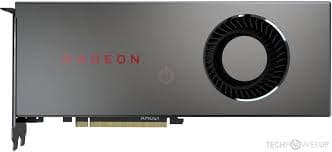
Radeon RX 5700 XT
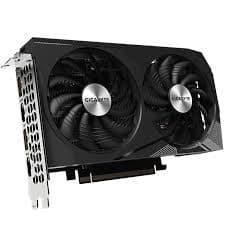
GeForce RTX 3060
avg, 1080p
The short answer
The RX 5700 XT is about 7% faster in pure raster fps and much cheaper used, but it has no ray tracing hardware, no DLSS, and it can't run some 2023+ titles that require mesh shaders. The RTX 3060 is slower on paper but carries the modern feature set and is still sold new. Pick the 5700 XT only if you are chasing the cheapest fps per dollar and don't care about ray tracing, DLSS, or future engine support, pick the 3060 for everything else.
These two cards come from different worlds. The RX 5700 XT is AMD's last pre-ray-tracing flagship class card from 2019, while the RTX 3060 is a 2021 mainstream card built around Nvidia's RTX feature set. Put head to head in pure raster fps, the older 5700 XT actually comes out slightly ahead. Add ray tracing, DLSS, and modern engine support to the picture, and the story flips.
What's below covers the full spec breakdown, real frame rates across ten games, exactly what the 5700 XT's missing RT and mesh shader hardware costs you in practice, thermals, power draw, price history, and a direct verdict.
At a glance
Seven dimensions, two cards. Bigger area is not automatically better, each card owns different corners.
Strengths radar
Each axis scored 0-100 relative to the pair
Performance vs price
Up and to the left is better value
Grey dots are neighbouring cards for context.
Which should you buy?
Pick your use case, the winner changes with what you actually do.
Faster average frame rate and cheaper on the used market, ray tracing and DLSS rarely matter in competitive titles anyway.
12 GB and a wider feature set age better even though the RX 5700 XT edges it in raw average fps.
CUDA and Tensor cores make the RTX 3060 the only sensible choice here, AMD's tooling on RDNA1 is thin.
NVENC has a slight quality edge over VCE at matched bitrate, though neither card has AV1.
At 170 W against 225 W, the RTX 3060 is the easier card to cool and power in a small case.
The RX 5700 XT lacks mesh shader support and can't run some newer engines at all, the RTX 3060 has no such ceiling.
Already own an RX 5700 XT? The RTX 3060 isn't a real upgrade.
Short answer: probably not
You would spend money to lose average fps, purely on paper the 3060 is the slower card. The trade is real feature access, ray tracing, DLSS, more VRAM, and a card that still gets active driver development, against a raw frame-rate loss most people would notice.
If you want a genuine upgrade, aim for an RX 6700 XT or an RTX 4060 Ti, both a real step up in every category. Only move sideways to the 3060 if you specifically need DLSS, ray tracing, or you keep hitting the 5700 XT's mesh shader wall in newer games.
Full specification comparison
Every spec side by side. The highlighted figure wins each row.
| Specification | RX 5700 XT | RTX 3060 |
|---|---|---|
| Architecture | ||
| GPU / architecture | Navi 10 · RDNA 1 | GA106 · Ampere |
| Process node | TSMC 7 nm ▲ | Samsung 8 nm |
| Release date | Jul 7, 2019 | Feb 25, 2021 |
| Launch MSRP | $399 | $329 ▲ |
| Compute | ||
| Cores (SP / CUDA) | 2,560 | 3,584 ▲ |
| RT cores | None, no HW RT | 28 · 2nd gen ▲ |
| Tensor cores | None | 112 · 3rd gen ▲ |
| Base / boost clock | 1605 / 1905 MHz ▲ | 1320 / 1777 MHz |
| L2 cache | 4 MB ▲ | 3 MB |
| Memory | ||
| VRAM | 8 GB GDDR6 | 12 GB GDDR6 ▲ |
| Memory bus | 256-bit ▲ | 192-bit |
| Bandwidth | 448 GB/s ▲ | 360 GB/s |
| Power & form factor | ||
| TDP | 225 W | 170 W ▲ |
| Power connector | 1× 8-pin + 1× 6-pin | 1× 8-pin ▲ |
| Suggested PSU | 600 W | 550 W ▲ |
| PCIe interface | 4.0 ×16 | 4.0 ×16 |
| Features | ||
| Upscaling | FSR 1/2, software only | DLSS 2 / Super Res ▲ |
| AV1 encode (NVENC/VCE) | No | No |
| Mesh shaders / DX12 Ultimate | No | Yes ▲ |
| Display outputs | 3×DP1.4 · HDMI 2.0b | 3×DP1.4a · HDMI 2.1 ▲ |
Average FPS by game
Switch resolution, metric, ray tracing and upscaling, the bars update live. Hover a bar for the avg / 1% / 0.1% breakdown.
Average FPS · 1080p · Rasterization. Representative data, hover a bar for avg / 1% / 0.1%. Note the RTX 3060's 1% lows fall off at 1440p and up from its 8 GB VRAM.
Smoothness & frametimes
Average FPS hides stutter. This is one run plotted as frametime, a flat line is smooth, spikes are hitches. Watch what the RTX 3060's 8 GB VRAM does in a texture-heavy game.
Frametime: Hogwarts Legacy, 1080p Ultra
Lower and flatter is better · 16.7 ms = 60 fps
Counterintuitive but real: the slower RX 5700 XT delivers a smoother line here because 12 GB holds the texture pool the 8 GB RTX 3060 keeps evicting, those spikes are VRAM stutter, not raw speed.
Lab scores
Clean apples-to-apples tests, useful, but weaker at predicting real games than the FPS above.
Ray tracing & upscaling
Ray tracing tanks both cards at native resolution. What makes it playable is upscaling, and here the RTX 3060 has a real edge.
Is frame generation "real" performance?
Neither card gets DLSS 3 Frame Generation, that stayed locked to RTX 40-series and newer. Both can use FSR 3 Frame Generation in the handful of games that support it, since it works across Nvidia, AMD and Intel hardware, though gains are smaller on cards this old because the frame-pacing overhead eats into an already lower starting frame rate.
Practically, don't lean on frame generation with either card. Neither reliably hits the roughly 50+ fps base rate where inserted frames feel good, so treat both as native-render cards and set expectations on the raw numbers above.
Will your CPU bottleneck these cards?
A faster GPU only helps if your CPU keeps up. Pick your CPU and resolution to see expected FPS and bottleneck for each card.
CPU + GPU pairing check
The willitbottleneck engine, built right into the comparison.
Estimated from a 43-CPU model across 1440p. A weak CPU mostly bites at 1080p; at higher resolutions the GPU becomes the limiter and the bottleneck shrinks.
Thermals & noise
The efficiency gap shows up here: the newer card runs cooler and quieter, day in and day out.
Real draw, efficiency & PSU
TDP is the rated figure; what matters is real gaming draw and how many frames you get per watt.
Both use a single 8-pin connector. If your PSU already ran the RX 5700 XT, it will run the RTX 3060 easily. Leave about 30% headroom for spikes.
Will it fit, and what to pair it with?
Size to scale
Card length matters for small cases
What monitor to pair
Both are 1080p-first cards. RX 5700 XT: comfortable at 1080p 144 Hz and crosses reasonably into 1440p 60-100 Hz thanks to its bandwidth. RTX 3060: a similar range, 1080p 144 Hz and 1440p 60-90 Hz. Treat 4K as occasional, lighter-game territory for either.
Running an older PCIe 3.0 board?
Both run a full PCIe 4.0 ×16 link, the RX 5700 XT was an early adopter of PCIe 4.0, so neither loses bandwidth even on an older PCIe 3.0 ×16 slot, where they would simply run at 3.0 ×16 speeds with a negligible, sub-2% difference.
Price history & dollars-per-frame
Raw price is only half the story. Cost per frame is the number that decides it, and it keeps moving as prices fall.
New price over time
Street price of new cards (USD)
The 8 GB vs 12 GB question
RX 5700 XT · 8 GB
- 8 GB is still enough for the large majority of 1080p titles in 2026 on high to ultra settings.
- The 256-bit bus and 448 GB/s of bandwidth are unusually generous for the VRAM size, which helps at higher resolutions.
- No RT cores means ray tracing modes simply aren't available, memory capacity doesn't change that.
- Missing hardware mesh shader support blocks or degrades a growing list of 2023+ engines regardless of VRAM.
RTX 3060 · 12 GB
- 12 GB is more headroom than most 1080p and even 1440p games ask for through 2026.
- The larger VRAM pool suits Stable Diffusion, small LLMs and bigger Blender scenes better than the 5700 XT's 8 GB.
- The narrower 192-bit bus and lower 360 GB/s bandwidth cap how much that extra capacity can be fed at once.
- None of it offsets the 3060 being the slower card in pure raster fps.
Emulation & memory bandwidth
The narrower bus is a real downgrade for emulation
High-resolution emulation, Switch, PS3, and upscaled GameCube titles, leans on raw bandwidth and shader throughput more than VRAM capacity, and the RX 5700 XT's 448 GB/s and 2,560 stream processors give it an edge over the 3060 here. Vulkan-based emulators run well on RDNA1.
Creator, AI & streaming
The newer card is quicker per task, but the older card's extra VRAM unlocks larger jobs it can't fit at all.
Streaming: the AV1 encoder is the differentiator
Neither card has a modern AV1 encoder. The RX 5700 XT is limited to VCE H.264, and the RTX 3060's NVENC also stops at H.264/HEVC since AV1 encode only arrived with RTX 40-series. For pure encode quality the two are close, NVENC has historically had a slight edge, but neither is the best choice if AV1 streaming is the priority.
Overclocking & undervolting
The RX 5700 XT has real overclocking headroom on paper but runs hot and loud stock, most owners get more value from undervolting it than pushing clocks further. The RTX 3060 has modest headroom either direction and is already efficient enough that overclocking rarely matters.
Pros & cons
RX 5700 XT
- Faster in pure raster fps and has more memory bandwidth
- 8 GB GDDR6 on a wide 256-bit bus
- Far cheaper on the used market
- No ray tracing hardware at all and no DLSS
- Lacks mesh shader support, blocks some 2023+ games outright
- Runs hotter and louder, and driver feature support is winding down
RTX 3060
- Ray tracing hardware, DLSS upscaling, and 12 GB of VRAM
- Runs cooler, quieter and more efficient at 170 W
- Still sold new, with active driver and feature support
- Slower in pure raster fps despite being the newer, feature-richer card
- Narrower 192-bit memory bus limits how far that VRAM can stretch
Buying pitfalls
RDNA1 can't run some 2023+ engines
The RX 5700 XT lacks hardware mesh shader support, a requirement for titles like Alan Wake 2 and some UE5 games. On unsupported titles you'll get a software fallback with a heavy fps penalty, or the game may refuse to launch. This is a real ceiling, not a settings problem.
The RX 5700 XT is an old, end-of-life card
AMD ended mainstream feature driver updates for RDNA1 years ago, it still gets security and bug-fix drivers but no new feature work. Buying used in 2026 means accepting that ceiling permanently, budget for a real upgrade sooner rather than later.
RX 5700 XT vs RTX 3060: your questions answered
In pure raster fps, yes, it runs about 7% faster on average. But the 3060 counters with ray tracing hardware, DLSS, more VRAM, and driver support that's still active, so which one wins depends on whether raw frame rate or feature set matters more to you.
Go with the RTX 3060 unless you're chasing the lowest possible used fps per dollar. It's still sold new, keeps getting driver updates, and supports ray tracing and DLSS, features that only matter more as time goes on. The 5700 XT only makes sense as a very cheap used pickup for someone sticking to older or esports titles.
It still delivers solid 1080p frame rates in most games, but the cracks are showing. No ray tracing, no DLSS equivalent, and no hardware mesh shader support means entire newer titles simply won't run on it. Treat it as a cheap, older-game card rather than anything future-proof.
Not for fps, you'd actually lose average frame rate making that move. It only makes sense if you specifically want ray tracing, DLSS, or the extra VRAM for creator or AI work. Otherwise, put the money toward a genuine step up like an RX 6700 XT or RTX 4060 Ti instead.
The RTX 3060, and it's not close. AMD's ROCm and DirectML support on RDNA1 remains thin and slow next to Nvidia's CUDA and Tensor core path, and the 3060's 12 GB gives it more room to work with besides.
Neither has a modern AV1 encoder, that only arrived with RTX 40-series and RDNA3. NVENC carries a slight historical edge in encode quality over VCE, but for this specific pair, base it on the rest of the card rather than encoding.
Only the RTX 3060 can. The RX 5700 XT's RDNA1 architecture has no dedicated ray tracing hardware at all, ray tracing modes simply won't run on it.
The RTX 3060 runs DLSS 2 upscaling. The RX 5700 XT has no DLSS path, but both cards can use AMD's FSR upscaler, since it works on any modern GPU regardless of brand.
Only at 1080p paired with a genuinely weak CPU. Check the pairing tool above, a Ryzen 5 3600 or Core i5-10400F and up keeps either card fed without a real bottleneck.
The RX 5700 XT pulls around 218 W gaming and runs hotter and louder than the RTX 3060's roughly 166 W. If noise and heat matter in a tight case, the 3060 is the easier one to live with.
A solid 600 W supply covers the RX 5700 XT, 550 W is enough for the RTX 3060. A 650 W unit gives either one room for a CPU upgrade down the line.
The 5700 XT runs about 267 mm, the 3060 around 242 mm, measure your case's clearance either way. Both use a full PCIe 4.0 ×16 link, so an older PCIe 3.0 board costs less than 2% either way, not worth worrying about.
Not for modern AAA games, no. Both sit in the 1080p-to-1440p range, so treat 4K as an occasional bonus on lighter titles rather than the resolution to plan around.
The RX 5700 XT is used-only at this point, AMD stopped selling it years back, so buy carefully and check for mining wear. The RTX 3060 is still available new for a bit more, and tested used copies are common and generally safe.
The RTX 3060's Ampere architecture still gets full Game Ready driver support. The RX 5700 XT is on maintenance drivers only, AMD isn't adding new RDNA1 features anymore, though basic compatibility and bug fixes keep coming.
Mostly, but with a real gap. It lacks hardware mesh shader support, which a growing number of 2023-and-later titles require, Alan Wake 2 being the clearest example. Check a game's requirements before assuming it'll run.